Cloud native · 9 MIN READ
Dapr 1.19 RC4: what Go teams should test at service boundaries
The 16 October Dapr release candidate is a reason to rehearse actor lifecycle, metrics access, deadlines and retries. A practical test plan for Go services.
Event: · Reporting and practical analysis. Sources listed below.

A release candidate is an invitation to validate
Dapr Runtime 1.19.0-rc.4 was published on 16 October 2026. It is a release candidate, not evidence that the stable 1.19 release has shipped. The cited notes include an actor lifecycle fix that evicts an application actor instance before activation, metrics listen-address handling for sentry, operator and injector, a restriction of metrics endpoints to GET and HEAD, and reserved integration-test ports below the ephemeral range. Check the RC4 release page for the precise changes.
Those items provide useful prompts for a Go team’s rehearsal. A lifecycle change deserves a lifecycle test. A metrics-access change deserves an observability check. A test-port change is a reminder that integration environments have resource assumptions of their own. None of these observations means every application is affected in the same way.
The rest of this article is our proposed validation plan and architectural analysis. Use an isolated environment that resembles the relevant parts of production. Do not replace a stable runtime merely because an RC exists or because a planned release date appears in a tracking issue.
Draw the actual request path
Before selecting tests, draw the path a request takes. Identify the client, Go application, sidecar, destination service and any state store or broker involved. Mark the points where work can queue, fail, be cancelled or be repeated. This drawing should describe your deployment, not an idealised diagram copied from a product overview.
The Dapr service-invocation documentation and Go SDK reference describe the supported integration. Read them against the versions you intend to test. An application can use a runtime capability without transferring all responsibility for the application’s semantics to that runtime. The code still needs a clear answer for what an error means and whether an operation may safely be attempted again.
For a simple read request, an interrupted response may be inconvenient. For a command that charges an account or reserves stock, an interrupted response can leave the caller uncertain whether the side effect happened. The network boundary creates that uncertainty. A sidecar can help implement policies, but it cannot infer the business meaning of a repeated command.
Treat deadlines as one budget
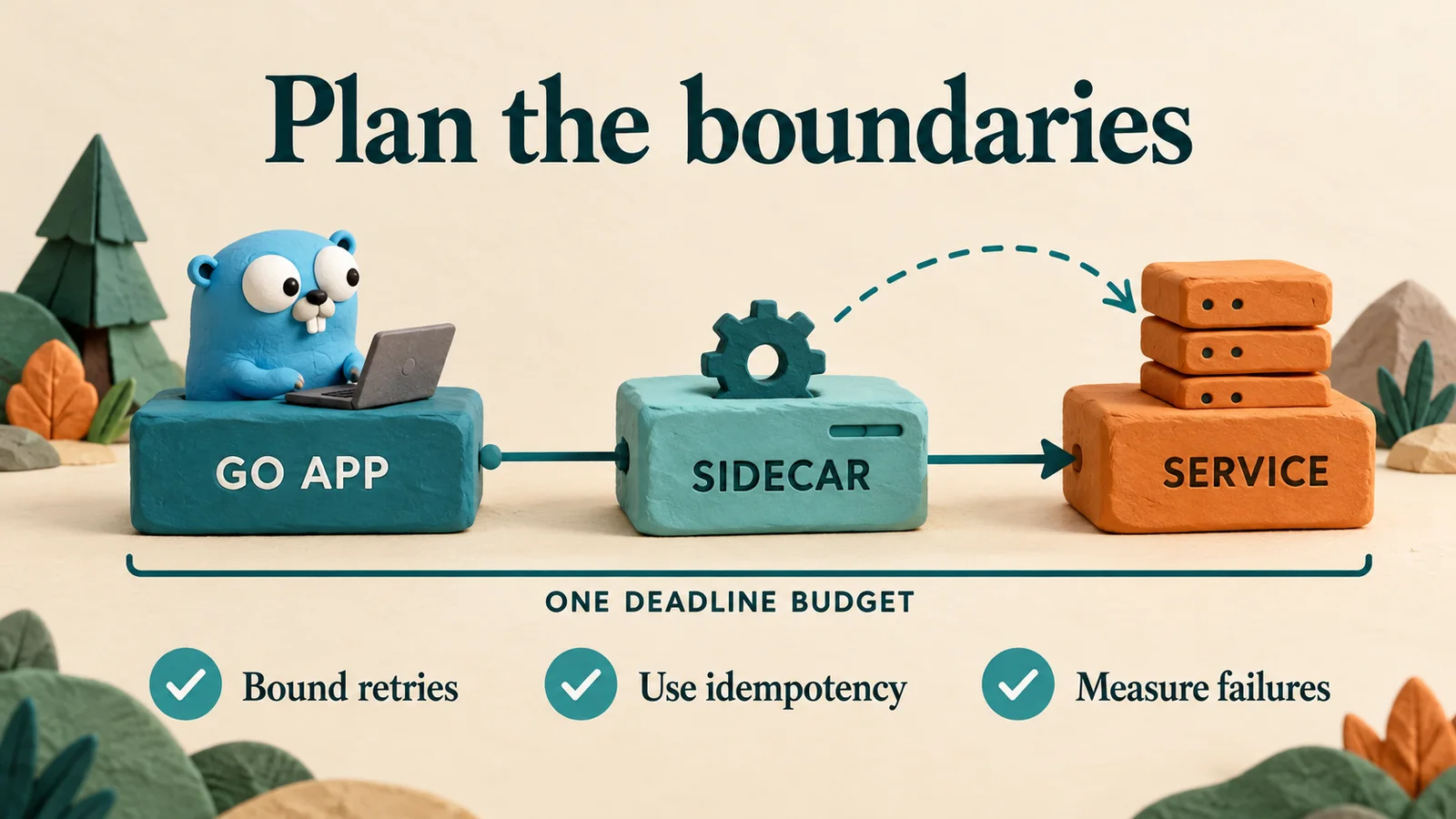
A request deadline represents the time available to finish useful work for a caller. If each layer starts a fresh independent timeout, the total operation can exceed the caller’s intended budget. The practical design question is how cancellation and remaining time are carried across each hop, and what work stops when that budget is exhausted.
In Go, begin with the incoming context and derive a narrower deadline only when the operation needs it. Release timer resources when the operation completes. Check the SDK and protocol behaviour for propagation rather than assuming a context in one process automatically controls every remote operation. Instrument the boundaries so a timeout can be attributed to waiting, transport or actual service work.
For a test, make the destination deliberately slow and cancel the caller early. Observe the Go handler, sidecar and destination separately. Does local work stop? Does the remote operation stop or continue? Is the result recorded consistently? A useful test documents the actual behaviour and its consequence, rather than declaring that cancellation works because one function returned an error.
Bound retries before a dependency becomes slow
Retries spend capacity. During a partial failure, several layers can each repeat an operation and multiply the load on the dependency that is already struggling. Before enabling a policy, identify which layer owns retries, which errors are eligible and how many attempts fit inside the request budget. Include the time spent waiting between attempts.
Dapr documents resiliency timeout and retry policies, but the right values depend on the operation and service constraints. Use those references to understand the mechanism, then choose a bounded policy that your service can explain. A retry on a safe lookup has different consequences from a retry on an externally visible mutation.
Build a test in which the destination fails the first attempt and succeeds on the next. Count actual calls, not just final successful responses. Then test persistent failure and verify that attempts stop. Repeat under concurrent load within a controlled budget. The goal is to discover amplification before a real outage teaches the same lesson at a much larger scale.
Idempotency belongs with the side effect
An idempotency key is useful only when the system that performs the side effect gives the key a precise meaning. Decide its scope, lifetime and relationship to the request payload. If the same key arrives with a different command, define whether that is rejected. If a process crashes after committing the effect but before replying, define how a later attempt retrieves the prior outcome.
Do not treat an in-memory map of recent requests as a complete solution for a distributed deployment. Multiple replicas and restarts change the ownership of that state. The durable record and the side effect may need a shared transaction or another carefully designed consistency relationship. The appropriate mechanism depends on the state system and the operation.
A good failure test interrupts the response after the effect is recorded. The client then retries the same logical request. Verify the resulting state, the returned outcome and the number of effects. This exercise connects the runtime retry policy to application semantics instead of testing the policy in isolation.
Actor lifecycle tests need visible state transitions
For an application using actors, make lifecycle transitions observable in the test harness. Identify when an instance is created, activated, deactivated or discarded, and what resources it owns. Then exercise the transition relevant to your application with a known runtime version. The RC notes tell you where to look; they do not replace an application-specific expectation.
Avoid adding broad logging of business data simply to observe lifecycle behaviour. Use bounded test identifiers and counters that show which instance handled an operation. Make teardown deterministic so a failed test does not leave resources that contaminate the next test. If a test occasionally passes because a prior instance remains alive, the test is not describing a stable contract.
Also distinguish in-memory state from persisted state. An instance lifecycle transition can affect local resources without implying a change in durable business records. Write assertions for both where relevant. This is the kind of boundary question that makes a Go architecture discussion practical rather than a comparison of diagram styles.

Metrics are part of the rollout contract
A deployment can remain reachable while losing the signals an operator needs to understand it. Include metrics access in the rehearsal. Confirm the intended listen address, the expected scrape method and the network path used by the collector. Test from the collector’s position rather than only from inside the service container.
Separate an endpoint’s availability from the interpretation of its values. A successful scrape does not prove that labels are stable or that an alert still measures the intended event. Compare a small known workload before and after the runtime change, and verify that the relevant signal changes in the expected direction. Keep high-cardinality request identifiers out of ordinary metric labels.
For an RC experiment, preserve a short record of the runtime version, configuration and observed metrics path. If the collector stops scraping, you should be able to tell whether the failure is address binding, network policy, method handling or application startup. That record makes a useful report to maintainers and a reusable regression check for your own team.
Resource limits change the shape of failure
A service that works with one request can fail when queues grow, pools saturate or memory becomes scarce. A runtime upgrade rehearsal should include a bounded concurrency test with an explicit stop condition. Measure active work and waiting work separately. Increasing concurrency without observing queues can hide the mechanism behind a single latency number.
Include the application’s dependency clients in the model. A Go handler may be waiting for MongoDB or Redis while the sidecar is still accepting work. Timeouts at the outer layer do not automatically release every inner resource. The Around Go material connects these concerns to client lifetimes, cursor ownership and pool pressure.
Choose test limits that protect the shared environment. A controlled saturation test does not need to become an uncontrolled stress test. Define the maximum request rate, duration, memory budget and cleanup procedure. The useful result is a documented failure boundary and a recovery observation, not the largest number a machine can briefly display.
Integrate containers and Kubernetes deliberately
A local container rehearsal can verify packaging, ports and startup assumptions. A Kubernetes rehearsal adds scheduling, probes, service discovery, termination and network policy. These are different environments, so state which one supplied each piece of evidence. Do not label a local success as a complete cluster validation.
For shutdown, start a request and then terminate the workload through the same mechanism used in deployment. Observe admission of new work, completion or cancellation of in-flight work and resource cleanup. Record whether the grace period is sufficient for the behaviour your service promises. If a request can be retried elsewhere, connect that observation back to idempotency.
Keep the runtime change separate from unrelated image, configuration and infrastructure migrations when possible. A small rollout surface makes a failure easier to diagnose and a rollback easier to execute. If multiple changes are required together, describe that dependency explicitly and test the combination you will actually deploy.
A useful RC report explains a reproducible boundary
When the rehearsal finds a problem, reduce it to the smallest useful reproducer. Include the runtime and SDK versions, relevant configuration, expected outcome and actual outcome. Prefer a bounded example with synthetic data over a raw dump from a private service. A report that another engineer can run is more actionable than a screenshot of an unexplained timeout.
Before moving to a stable release, repeat the required gate against the actual stable artifact. An RC test is valuable preparation, but it is not proof about an artifact that has not been tested. Retain the known-good deployment identifier and confirm the rollback path. Promotion should be a concrete action with an owner and an observable result.
For interview practice, explain why a timeout can leave a write outcome ambiguous and why a retry can multiply load. For implementation practice, trace one request across the course’s operational topics. The strongest lesson from an RC is often a clearer understanding of your own system’s boundaries: who owns the work, how long it can live, and what evidence tells you it finished.
Primary sources & editorial method
We checked these primary references on 20 October 2026. Release facts are attributed; recommended workflows and examples are GopherForge analysis. Illustrations are conceptual, not vendor screenshots or benchmarks.