Security · 9 MIN READ
Go 1.27.3 and 1.26.10: turn a security patch into deployed evidence
The 19 October Go patches address crypto/x509. Here is a practical inventory, rebuild, test and rollout workflow without inventing vulnerability details.
Event: · Reporting and practical analysis. Sources listed below.

What the official release confirms
The Go release history records Go 1.27.3 and Go 1.26.10 on 19 October 2026. Both include security fixes in crypto/x509. That is the confirmed scope used here. This article does not assign a CVE, severity, exploit condition or affected deployment pattern that is not stated in the cited release information. Consult the official release history and linked milestones for the authoritative details as they develop.
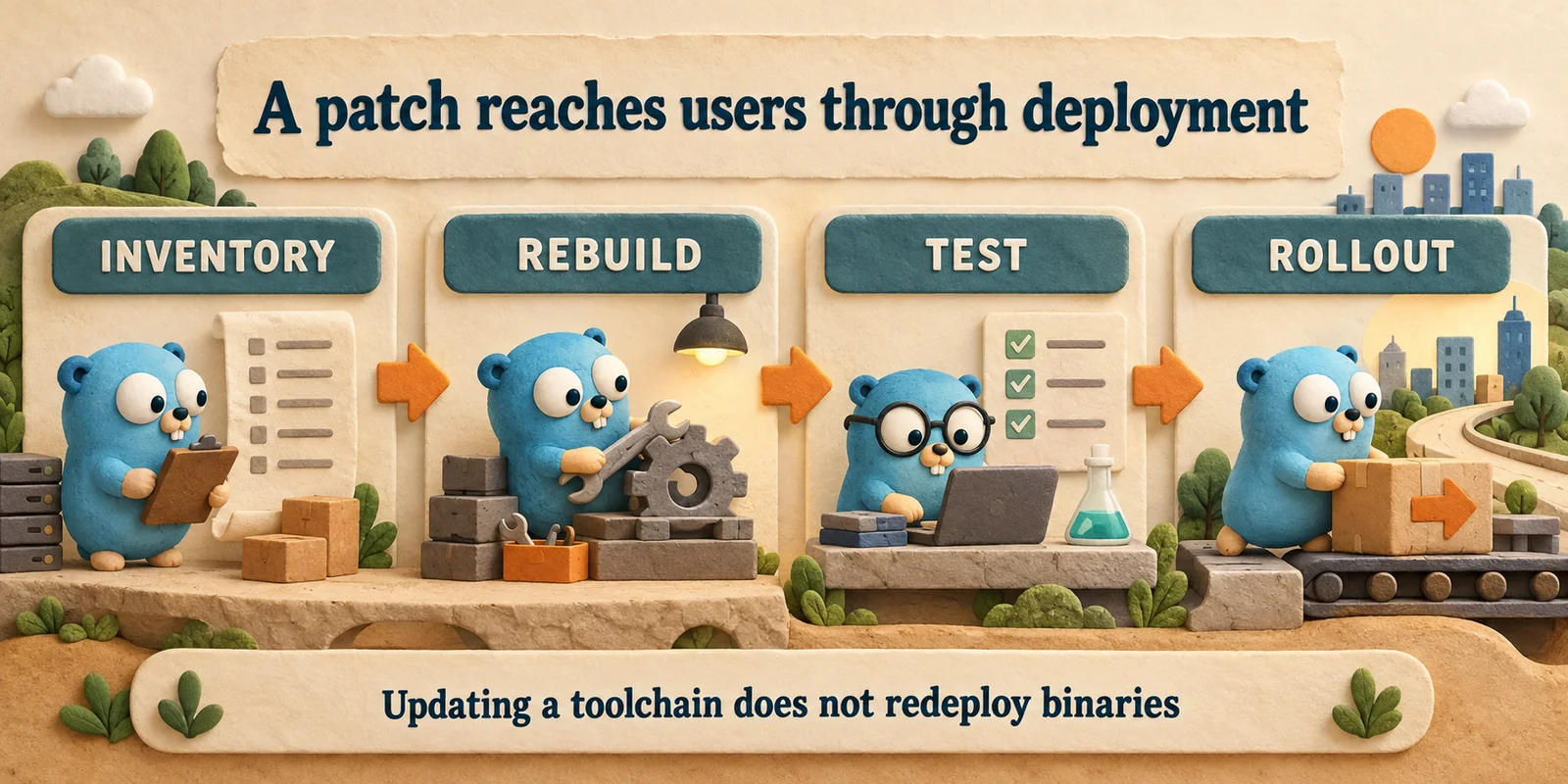
For a service owner, a patch announcement opens an operational question: which running artifacts were built with the affected toolchain, and how will replacement artifacts reach users? Updating a developer laptop answers only one part of that question. Build workers, cached container layers, scheduled jobs and long-lived command-line binaries may follow different update paths.
The workflow below is our maintenance guidance, illustrated with commands and review questions. It should be adapted to your release process, exposure and required change controls. The objective is evidence connecting a patched toolchain to a specific deployed artifact, rather than a reassuring version number in an unrelated terminal.
Begin with artifacts and owners
Make a short inventory of the programs you operate. Include the API service, background workers, scheduled maintenance tools and administrative binaries. For each one, identify an owner, a source revision, a build path and the deployed artifact identifier. A service with no known owner is harder to patch because nobody can make a defensible decision about its acceptance tests or rollback.
Distinguish a source repository from its outputs. One repository can produce several binaries, and those binaries may be deployed on different schedules. Likewise, a container image can contain an application binary built somewhere else. Updating the final image’s operating-system packages does not demonstrate that the embedded Go binary was rebuilt with a new standard library.
Start with the systems whose ownership and deployment path you understand. Record uncertainty explicitly for the rest. A small table that says “build toolchain unknown; owner assigned to investigate” is more useful than marking every service patched because a shared base image changed. The inventory becomes the work queue and later provides the evidence for closing it.
Inspect both the build environment and the binary
The Go tool can report its own version and inspect build information stored in a binary. These observations answer different questions. The first describes the toolchain you invoked; the second describes an artifact. Preserve both when they are relevant to a patch investigation, along with the artifact’s immutable identifier.
# Run in the intended build environment.
go version
go env GOTOOLCHAIN

# Inspect a specific Go binary; replace this example path.
go version -m ./bin/service
Treat the output as evidence with a scope. A local binary is not necessarily the binary in the running container. A container tag is not necessarily immutable. Compare a digest or another reliable release identifier with deployment state, and make the relationship explicit in the release record.
The runtime/debug package also exposes build information to Go programs. If your service already has a private diagnostic endpoint or startup log, an intentionally chosen subset can help identify the running build. Avoid publishing private module paths or complete environment details unnecessarily. The goal is to answer operational questions, not to turn diagnostics into an uncontrolled inventory of internal infrastructure.
Toolchain selection must be reproducible
A project’s selected toolchain can depend on the environment and the module’s directives. The Go toolchains documentation explains how the go command chooses a toolchain and how automatic selection works. Read that behaviour in the context of your build, especially when a workstation and CI seem to disagree about the version in use.
Pin or otherwise record the approved build inputs using the mechanisms your team maintains. A reproducible build recipe is more valuable than a one-time manual command that nobody can repeat. Confirm the selected version inside the actual build job instead of assuming that changing a workstation setting changed the remote worker.
Check caches deliberately. A cache can save time while still using an old builder image or an already-produced binary. You do not need to delete every cache reflexively; you need to know which inputs control the output and prove that the replacement artifact was produced with the intended toolchain. Keep dependency upgrades separate unless they are required for the patch, so the review remains focused.
Test certificate behaviour with realistic assumptions
The crypto/x509 package deals with certificates and verification. A patch in this area should prompt you to identify the certificate-related behaviour your application actually relies on. That can include outbound connections, internal certificate chains or explicit verification code. Read the package documentation rather than assuming every certificate operation uses identical rules on every platform.
Use representative test fixtures that are safe to keep in the repository. Include the chain structure and verification inputs that matter to your service. Do not copy production private keys into a test suite. A fixture should explain what it represents and why the expected result is correct, so that future maintainers can distinguish an intentional rejection from a regression.
Avoid weakening verification to make a failing test pass. If a patch exposes a previously hidden assumption, investigate the trust configuration and expected identity. A maintenance change should improve the evidence around the boundary. It should not remove the boundary in order to preserve a green status indicator.
Separate correctness checks from rollout checks
A unit test demonstrates behaviour under the conditions it exercises. An integration test checks a wider interaction. A rollout check asks whether the intended artifact is running and whether its operational signals remain acceptable. These are complementary forms of evidence, and none should silently substitute for the others.
Run the repository’s required tests with the patched toolchain. Include the relevant certificate or connection tests and any build targets that differ from the developer default. Where the application supports multiple operating systems or architectures, make clear which targets were rebuilt and tested. A successful Linux build does not automatically validate every supported target.
Then define the operational acceptance criteria before deployment. Choose signals tied to the service: connection failures, request errors, startup success, certificate verification failures or another relevant indicator. Write down the observation period and the response to an unexpected result. A canary that nobody watches is merely a smaller deployment, not a meaningful safety check.
Rebuild once, promote the reviewed artifact
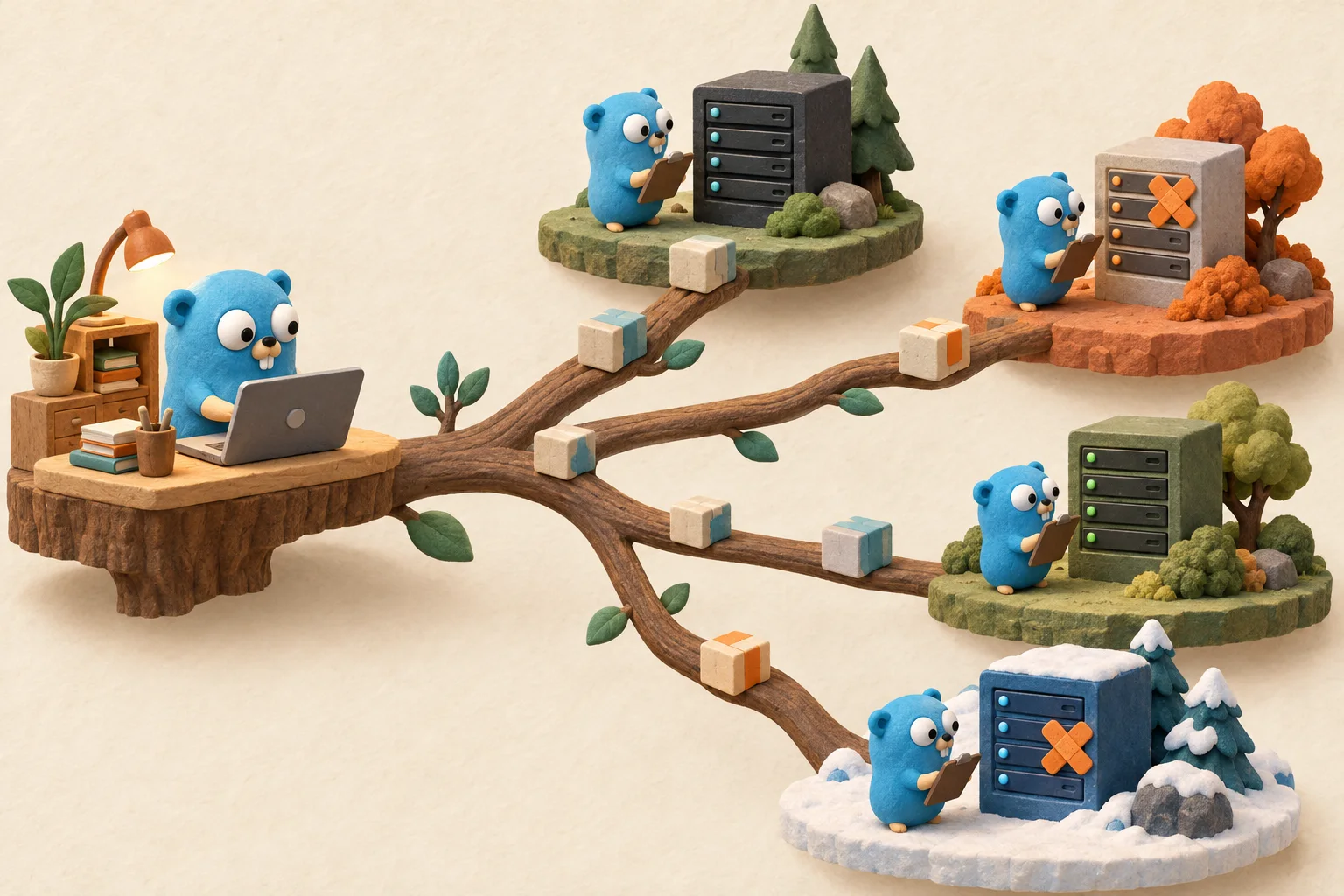
Where your delivery process permits it, build an artifact once and promote that reviewed artifact through environments. This reduces the chance that production receives a different output from the one tested in staging. Record the source revision, toolchain, build job and artifact identifier together. The record should be easy to find during an incident.
For containers, distinguish the source build image from the final runtime image and the registry manifest from a mutable tag. The exact mechanics depend on your platform, but the underlying question is stable: can you point from the running workload to the artifact that passed the required gate? If not, improve that relationship before declaring the maintenance complete.
Keep rollback practical. Retain the previous known artifact and the configuration needed to restore it. A security-related rollback may have its own risk tradeoff, so decide who can make that decision and how an investigation will proceed. The important point is to make the fallback concrete rather than relying on a vague promise that the old build can be recreated later.
Vulnerability tooling complements the release record
The Go vulnerability documentation describes tools and databases for identifying known vulnerabilities relevant to a program. Use the recommended tooling as part of the evidence, with its version and database state understood. A vulnerability report and a release announcement answer related but different questions: one describes known issues in a context, while the other describes a published fix.
A clean report is not a universal proof of safety. Tooling can only report within its model and available information. Conversely, a match needs interpretation: determine the affected code, relevant call paths and the artifact being analysed. Record the conclusion with enough detail that another engineer can review it without repeating every step from memory.
For dependency work, the module management documentation is a useful companion. Keep module changes deliberate and inspect go.mod and go.sum diffs. A rushed blanket upgrade can introduce unrelated behaviour and make a focused security patch harder to validate. Small, explained changes make both review and incident response more reliable.
Embedded toolchains have a separate delivery lifecycle
A product that embeds a compiler or runtime has to ship that component through its own release process. GopherForge currently bundles Go 1.27.1 in the native release discussed in our product update. This article reports the upstream patches; it does not imply that writing about them has already updated the application’s embedded toolchain.
The same distinction applies to desktop tools, build appliances and packaged developer environments. Inventory the embedded component, determine the relevant exposure and plan an appropriate rebuild and product release. Track that work explicitly. Customers need accurate version information rather than an announcement that conflates upstream availability with downstream delivery.
For a learner, this is a valuable architecture lesson. A dependency crosses several boundaries before it reaches a user: source selection, compilation, packaging, review and deployment. Understanding those boundaries makes it easier to reason about why an apparently simple version bump can require several separate checks.
Close the task with verifiable evidence
A complete maintenance record should identify what was rebuilt, what passed, what was deployed and what remains uncertain. Include the immutable artifact, the selected toolchain, the relevant test results and the observation that the intended workload is running. If some secondary binary still needs work, leave it visibly open with an owner.
Use this incident-free maintenance opportunity to improve the next update. Can a new engineer discover the toolchain used by a running service? Can a scheduled job be rebuilt without recovering a departed employee’s workstation? Can the team distinguish a patched build from a retagged old image? These questions often reveal more useful follow-up work than adding another status badge.
Continue with Around Go for operational context, or practise explaining deployment evidence in Interview. For the editor side of the toolchain, see the VS Code upgrade workflow. A patch reaches users through a chain of concrete actions; the engineering task is to make every link in that chain observable.
Primary sources & editorial method
We checked these primary references on 20 October 2026. Release facts are attributed; recommended workflows and examples are GopherForge analysis. Illustrations are conceptual, not vendor screenshots or benchmarks.