NETWORKING & SERVICES · 10 MIN READ
Go 1.27 HTTP connection reuse: close the body, measure the result
What Go’s bounded HTTP/1 response cleanup changes, and how to review shared clients, deadlines, connection traces and retries before a production rollout.
Event: · Reporting and practical analysis. Sources listed below.

The change behind the headline
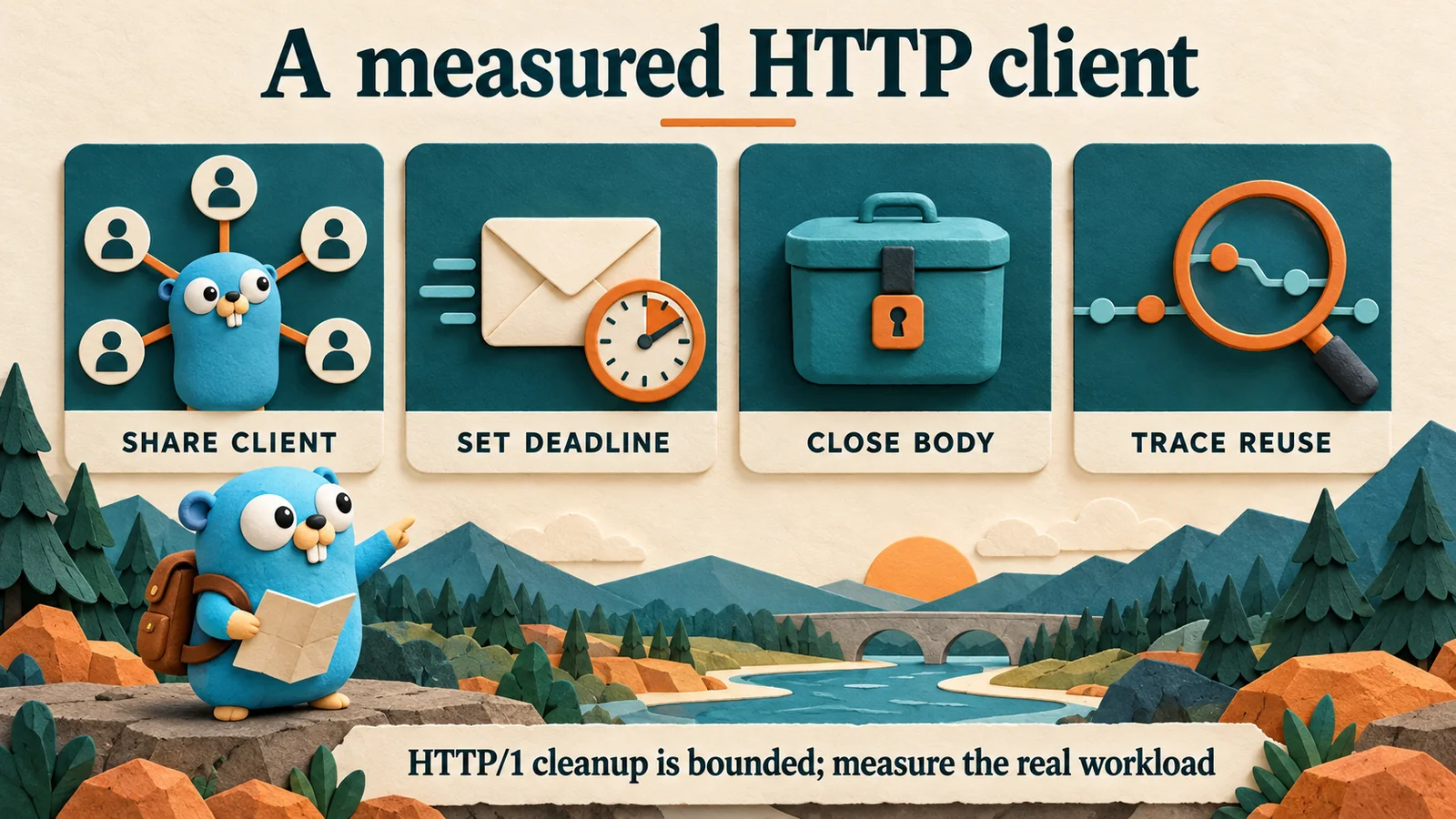
On 14 October 2026, the Go team explained a Go 1.27 improvement to HTTP/1 connection reuse. The transport can perform bounded asynchronous cleanup of an unread response body after it is closed. The published implementation description gives limits of 50 milliseconds or 256 KiB; these are implementation details that can evolve. The recommended application pattern remains straightforward: close a response body when you no longer need it.
This is a useful improvement for clients that inspect a response’s status or decode a small document without consuming every final byte. It is not a promise that every request will reuse a connection, and it does not make arbitrary network work free. The official explanation is the source for the release facts. The rest of this article develops a practical review exercise: how to decide whether a real Go service benefits, how to measure the effect, and which responsibilities still belong in the application.
Start with a concrete client workflow
Consider an order service that calls a small account-status endpoint before accepting a purchase. The response body contains a short explanation, but the order service only uses the status code. Engineers notice that the upstream sees many new connections even though the requests are sequential and the service uses the same client. That observation is worth investigating; it is not yet proof of a transport bug.
Write down the complete request path. Include the application client, any sidecar or proxy, the upstream server and the protocol negotiated on the actual connection. A local development call can use a different protocol from production. A proxy may also impose its own connection lifetime. Without that map, an experiment can attribute a change to Go while actually measuring a different network path.
Choose a representative sequence of requests and keep the upstream behavior fixed. Record the payload size and whether the caller reads it. Use a test endpoint under your control rather than repeatedly probing an unrelated public service. The aim is to observe your client’s lifecycle, not to generate a persuasive-looking latency number from an uncontrolled network. Our Go service lessons are a useful place to revisit the request boundary first.
Keep ownership of the response explicit
A successful HTTP call hands the application a response body with a lifecycle. Decide which function owns it and where that ownership ends. The function that receives the body should either consume and close it or transfer responsibility through an explicit interface. Returning a body without documenting that transfer makes cleanup depend on callers remembering an invisible convention.
A small helper can keep the common status-only case readable. This fragment is intended to live in a package that already imports context and net/http; its caller supplies a shared client and an approved endpoint.
func fetchStatus(ctx context.Context, client *http.Client, endpoint string) (int, error) {
    req, err := http.NewRequestWithContext(ctx, http.MethodGet, endpoint, nil)
    if err != nil {
        return 0, err
    }
    resp, err := client.Do(req)
    if err != nil {
        return 0, err
    }
    defer resp.Body.Close()
    return resp.StatusCode, nil
}
The helper does not invent a retry policy or convert every non-success status into a transport error. Those are separate product decisions. Keep them visible at the layer that understands the operation. This separation makes the example easier to test and prevents a connection-cleanup improvement from accidentally changing business behavior. The HTTP package reference documents the client and response contracts behind the fragment.
Use one budget for the operation you mean
The account-status request is part of a larger operation. Decide how much of the user-facing deadline it may consume, and pass that budget through the request context. A faster cleanup path does not justify leaving the operation without an upper bound. It also does not make an expired request useful simply because a connection might later return to a pool.
Write the budget in terms that the product and operations teams can understand. For example, the order service may choose to stop waiting for account status before the overall checkout deadline expires, leaving time to return a controlled response. The exact duration depends on the service’s requirements and observed behavior; the article intentionally does not prescribe a universal number.
Then test the boundary. Make the upstream delay headers, delay the body and terminate a connection partway through a response. Observe the error returned to the caller and verify that the service does not continue performing user-visible work after its owner has stopped waiting. These tests answer a different question from connection reuse, but they belong in the same review because both concern the lifetime of network work. The context reference is the primary API guide.
Trace a connection instead of guessing from latency
Latency alone is an ambiguous signal. A request can become faster because of a warm DNS cache, a nearby backend, a different TLS path or less server work. Add a connection-level observation when investigating reuse. Go’s net/http/httptrace package exposes hooks that can help associate a request with connection acquisition and reuse.
For a controlled diagnostic run, attach a trace and record whether the transport reports a reused connection. Keep the output small and avoid including request credentials or sensitive URLs. This fragment illustrates one observation point; it is not a complete production telemetry system.
trace := &httptrace.ClientTrace{
    GotConn: func(info httptrace.GotConnInfo) {
        log.Printf("http connection reused=%t idle=%t", info.Reused, info.WasIdle)
    },
}
ctx = httptrace.WithClientTrace(ctx, trace)
Use the same observation in the before-and-after experiment. Record the toolchain and the negotiated protocol with the test description. If a proxy sits between the application and upstream, be precise about which connection the trace describes. The httptrace documentation is the source for these hooks. A trace gives the team a sharper question than “the new release felt faster,” while leaving room for end-to-end measurements that matter to users.
Build a matrix that includes the awkward cases
A useful experiment includes more than the ideal small response. Add an empty body, a short body that is ignored, a body that is fully consumed, an oversized body and a body delivered slowly. Run the cases through the protocol paths you actually support. Record whether the application intentionally stops reading and whether the server permits the connection to remain open.
Do not force HTTP/1 in production just to reproduce a demonstration. A protocol override can be useful in a controlled experiment, but it changes the workload being measured. Likewise, an HTTP/2 result should not be interpreted as evidence for an HTTP/1 cleanup mechanism. Make the protocol a column in the experiment rather than a footnote.
Choose an observation window long enough to include connection cleanup and the next request, while keeping the request sequence repeatable. Count new connections and completed operations alongside latency. If a cleanup improvement reduces connection churn but the application’s latency remains dominated by a database call, that is still a meaningful result. Report the narrower benefit accurately instead of inflating it into an application-wide speedup. The release gives you a hypothesis; the matrix helps decide whether that hypothesis applies to your service.

Revisit custom draining helpers carefully
Older codebases often contain a helper that reads and discards a response body before closing it. Find the call sites and understand the helper’s original purpose before removing it. Some helpers also enforce a payload limit, attach diagnostics or support an older toolchain. A function name such as cleanupResponse can hide several responsibilities that should not all disappear during a transport upgrade.
Review one call path at a time. Decide whether the caller needs to validate the complete response, whether the remaining bytes matter to the protocol the application implements, and which Go versions the package supports. Keep behavior-focused tests around the contract. A change that improves connection handling should not silently accept a response the application previously rejected as malformed.
Prefer a small migration with visible evidence to a repository-wide search-and-delete. The interactive-refactoring analysis describes why choosing the intended change before applying it makes review easier. The same principle applies here even if the editor can automate the mechanical edit. A tool can find a helper; it cannot decide which part of the helper represents an application guarantee.
Keep retries separate from reuse
A reusable connection is not permission to repeat an operation. Suppose the account-status endpoint is replaced by a payment reservation endpoint. A transport failure may leave the caller uncertain whether the upstream performed the action. Repeating the request without an application-level strategy can create duplicate work even if the connection pool behaves perfectly.
Describe the retry decision in terms of the operation’s semantics. Decide which failures are retryable, how much deadline remains, how attempts are bounded and whether an idempotency mechanism exists. Then verify that those choices are preserved when the client implementation changes. Do not hide an unlimited retry loop behind an apparently convenient HTTP helper.
This is also where sidecars and SDKs deserve attention. If the application retries and another layer retries independently, the number of upstream attempts can grow beyond what either author expected. Trace an entire failed operation through the system. Our Dapr boundary analysis discusses the related problem of coordinating budgets across layers. The HTTP improvement is welcome, but the application still owns the meaning of repeating an action and the point at which it should stop.
Make the rollout observable and reversible
Package the transport upgrade as a release with a known candidate and a clear comparison period. Watch completed operations, errors, connection creation and resource use together. A lower connection count is not a win if requests now fail more often, and a stable average can hide a changed tail. Keep enough context to separate a code change from a simultaneous upstream rollout.
Write down the rollback trigger before deploying. It should refer to user-visible behavior or an agreed operational constraint, not to an arbitrary desire for every graph to move in the same direction. Preserve the previous artifact and identify the running version after each rollout step. The reproducible-build report analysis explains the complementary task of connecting source, artifact and deployment evidence.
After the rollout, summarize the actual result. State the protocol, workload and observation window. If the effect is too small to distinguish from noise, say so. A careful “no measurable end-to-end change in this workload” is useful engineering information. It keeps future optimization work focused on the real bottleneck and prevents an upstream demonstration from becoming an unsupported performance claim in your own product documentation.
A review exercise worth keeping
Take one status-only request in your application and ask a teammate to explain its ownership, deadline and retry policy. Then show the connection trace for a representative test. The exercise should reveal where cleanup happens and which layer owns the decision to abandon a slow operation. If those answers require reading unrelated global helpers, simplify the boundary before adding more tuning knobs.
For interview preparation, change one assumption at a time. What if the body becomes large? What if a proxy closes every connection? What if the operation stops being safe to repeat? These questions turn a release note into a discussion of network lifecycle and application semantics. Use the network-service interview material to practice a full explanation rather than memorizing a preferred helper function.
Go 1.27 removes some delicate cleanup work from ordinary application code. Teams can benefit most by keeping that code small, retaining explicit ownership and measuring the actual path. Close the body, preserve the operation’s budget, and let evidence determine whether connection reuse was the problem you needed to solve.
Primary sources & editorial method
We checked these primary references on 21 October 2026. Release facts are attributed; recommended workflows and examples are GopherForge analysis. Illustrations are conceptual, not vendor screenshots or benchmarks.