TOOLCHAINS & DELIVERY · 10 MIN READ
Go’s 21 October build report: verify the toolchain, then your release
Today’s Go reproducible-build report, explained through a practical release recipe: controlled inputs, independent rebuilds, artifact comparison and rollout evidence.
Event: · Reporting and practical analysis. Sources listed below.

Today’s report, and the question it answers
The official Go reproducible-build report records a verification run on 21 October 2026, starting at 00:02:30 UTC and finishing at 02:02:02 UTC. Its release results include successful checks for Go 1.27.3 and Go 1.26.10. This is a dated observation of the public report, not an announcement of a new Go release. The report changes daily; a future visit can show a different run.
For a team preparing a deployment, this is useful evidence about the compiler distribution it intends to use. The next question is closer to home: can another engineer identify the inputs to your application build and explain the artifact that reached production? An upstream verification report and an application release receipt answer different questions. This article connects them through a practical release exercise, without presenting a green report as a complete security assessment. Start with the official report, then keep a copy of the specific evidence your release decision used.
Separate the compiler from the service
Imagine a small Go service that exports invoices. The team chooses an official compiler, downloads dependencies, generates a client, compiles a binary, packages it in an image and deploys that image to two regions. Each arrow creates another opportunity for a relevant input to go unrecorded. A trustworthy compiler archive cannot explain why one region runs yesterday’s generated client or why a packaging job selected a different base image.
Draw those steps before adding another verification badge. Give each artifact a name and an owner. The compiler distribution belongs in the build environment record. The generated client belongs in the source or generation record. The application executable needs its own identity, and the deployed image needs the digest that the runtime actually selected. A single field called “version” cannot carry all these relationships.
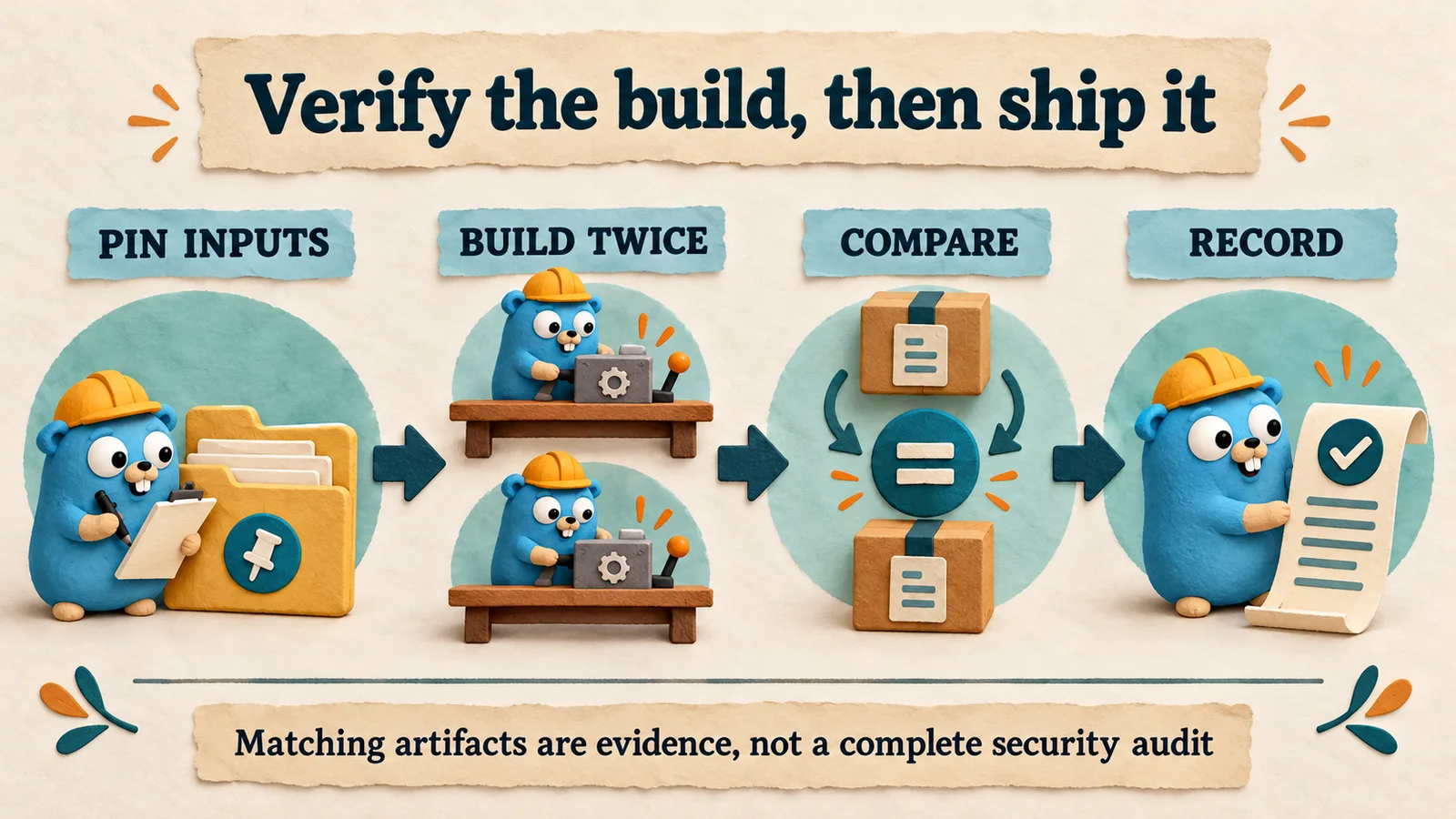
Our recommendation is to write one sentence for each boundary: what went in, what came out, and where the evidence lives. This makes the eventual incident question much smaller. Instead of debating whether the build was generally secure, the team can ask whether a specific output came from the expected inputs. That is an operationally useful question even when the whole supply chain is still being improved.
Define the comparison before running it
A reproducibility exercise needs an explicit object of comparison. Comparing executable bytes is different from comparing an archive that also contains timestamps, ownership information, signatures or documentation. Two installation packages can differ while containing the same application payload. Conversely, matching file names tell you nothing about matching contents.
Choose the smallest artifact that represents your application contract, and write the comparison rule down. For a simple pure-Go command, that may be the executable. For a signed desktop package, the procedure may compare a defined unsigned payload before signing and then separately record the signed distribution. Do not silently remove differences until the comparison passes. Every normalization step changes what the result proves.
Use a deliberately ordinary service for the first exercise. A tool with one main package and no generated assets is easier to understand than your most complex production image. Once the team can explain a mismatch in that small case, it can extend the procedure to code generation, embedded files and packaging. This is a learning sequence, not an instruction to postpone urgent maintenance. Continue to ship necessary fixes through the established release process while strengthening the evidence around it.
Make a release receipt that another person can use
A useful receipt starts with the source revision, the selected toolchain, target operating system and architecture, build command, dependency graph and output digest. Add the generator version if generated source is part of the build. If a profile-guided optimization input is selected, record the profile’s identity too. A human-readable note should explain any intentional variation between targets.
Avoid collecting an indiscriminate environment dump. Build jobs often contain credentials and unrelated machine details. Record the approved inputs that affect the artifact, while keeping secret material in the existing secret system. The goal is a reviewable recipe, not a transcript of every process variable on the runner.
For the invoice service, a reviewer should be able to answer three questions from the receipt: which source produced this executable, which recipe produced this image, and which image did the deployment select? Put links between those records. A digest written in a build log is much less useful if nobody can find the matching rollout record two weeks later. Store receipts beside release evidence with a retention policy that fits the support life of the release. Ownership and retrieval are part of the design, not administrative details to add after an incident.
Try a controlled two-build exercise
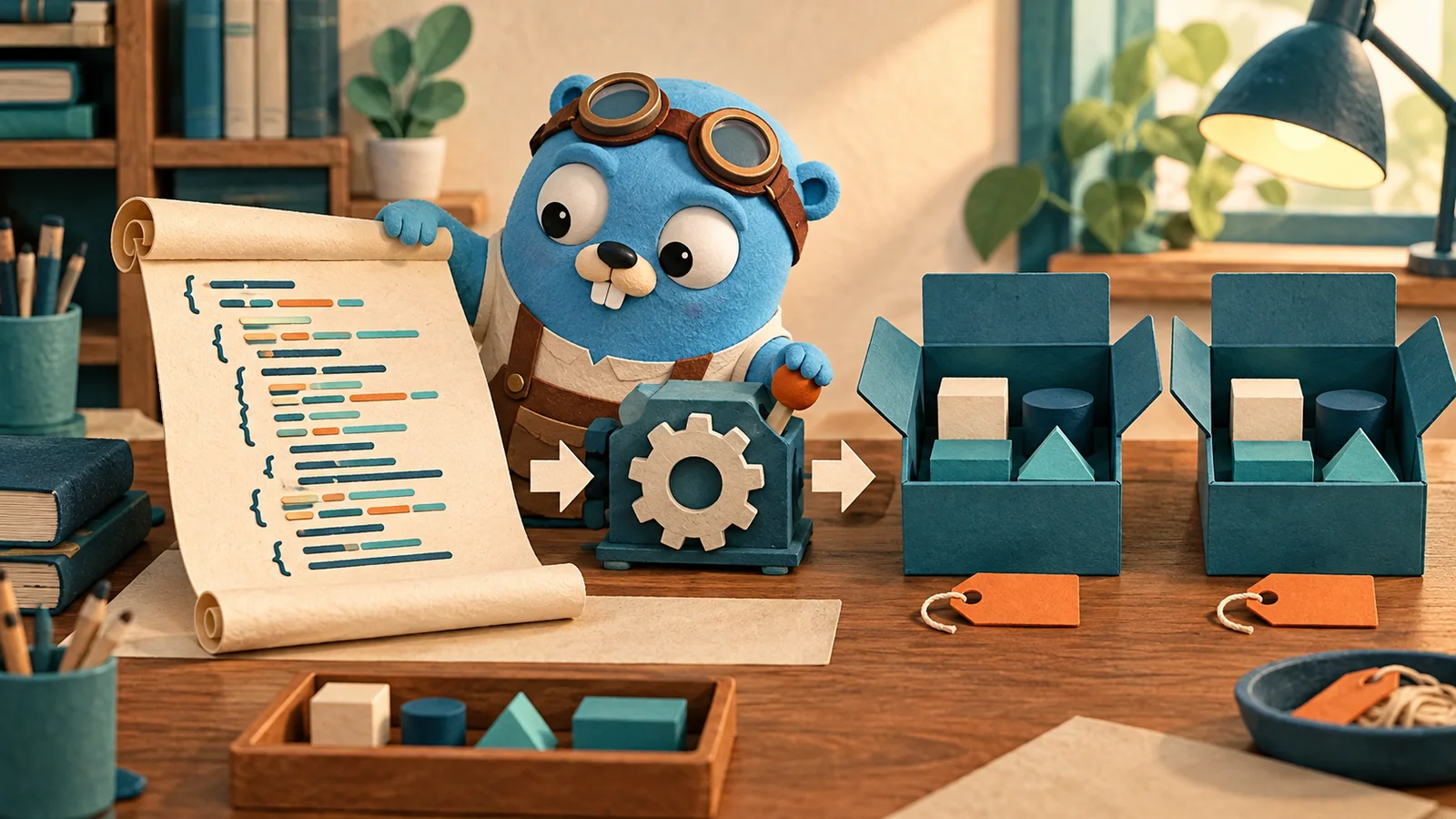
The following commands illustrate a starting point for a pure-Go command in a repository with ./cmd/service. Run them in a controlled development or CI environment, using the toolchain your team has selected. They are a recipe to adapt, not output from a benchmark performed for this article.
go version
go env GOOS GOARCH CGO_ENABLED GOTOOLCHAIN
go list -m all
CGO_ENABLED=0 go build -trimpath -o ./out/service-a ./cmd/service
CGO_ENABLED=0 go build -trimpath -o ./out/service-b ./cmd/service
cmp ./out/service-a ./out/service-b
go version -m ./out/service-a
Check that ./out exists, preserve the command’s exit status and retain the actual module and environment output with the receipt. A same-runner comparison is a useful first check, but it is weaker than an independent rebuild on another controlled runner. Make the second exercise deliberately independent rather than simply running the same cached job twice and calling it verification.
When a difference appears, preserve both outputs and investigate the inputs. Do not fix a release by choosing whichever binary happens to match a preferred checksum. The comparison is diagnostic evidence; it does not decide which output is correct by itself. The Go command reference explains the flags and build-information inspection used here.
Treat cgo, generators and profiles as real inputs
The simple recipe above disables cgo. That is appropriate only when the application supports that configuration. A service that depends on a C library cannot gain a sound release process by having that dependency switched off without understanding the behavioral change. Record the C compiler, library versions and relevant linking choices when they are part of the application.
Code generation deserves the same treatment. Consider a schema file that is committed, while its generator is downloaded using an unpinned command. The source revision then fails to describe all the source that the compiler sees. Decide whether generated files are reviewed in the repository or regenerated through a pinned, reproducible step. Either policy can be workable; an unexplained mixture is difficult to audit.
Profiles are another easy omission. A performance profile is data used by an optimizing build, so keep its identity alongside the command that selected it. Separate the question “was this a representative workload?” from “which exact profile did the build consume?” The first needs engineering judgment; the second needs a durable record. Our modules and tooling interview guides provide a useful preparation route for explaining these decisions aloud before implementing them in CI.
Add independence without turning CI into a ritual
Give the rebuild job a clear purpose and budget. For a small team, an independent verification on a release candidate may be more practical than doubling every development build. For a compiler or widely distributed command, more frequent verification may be justified. Decide who reviews differences and what the release gate does when the verification infrastructure itself is unavailable.
A healthy policy distinguishes a mismatch from an infrastructure failure. A missing artifact, an unavailable source host and a different executable are different incidents. Each needs evidence, but they should not be reduced to a single opaque red badge. Keep enough context to reproduce the problem without preserving credentials or unrelated job traffic.
Also rehearse a deliberate mismatch. Change a harmless recorded build input in a test repository and verify that the check notices. Then restore the expected input and verify that the evidence explains the recovery. This exercise tests the procedure’s ability to detect and communicate a difference. It is more useful than celebrating a long history of green jobs whose comparison rule nobody has read. The value comes from a reviewable chain of decisions, not from the number of dashboards attached to a release.
Keep reproducibility beside vulnerability review
Matching an artifact to expected source does not establish that the source is free of defects. The team still needs dependency review, vulnerability analysis, tests and a sensible response to disclosed problems. Conversely, a clean vulnerability scan does not show that a downloaded executable was built from the expected source. These controls complement one another because they address different failure modes.
For the invoice example, create two separate release questions. First: does the candidate correspond to the reviewed source and recipe? Second: is that reviewed program acceptable to deploy now? The second question includes application behavior, operational risks and the effect of changes on users. Keep the answers linked, but do not merge them into a single claim that the software is “verified” without defining the word.
This also makes communication with users more accurate. Say what was checked, identify the version and explain the scope. Avoid promising that reproducible builds prevent every supply-chain attack. A documented, narrow claim is easier to maintain and more credible than a broad slogan. Our security-patch deployment analysis covers the separate task of getting a rebuilt fix into the actual running fleet.
Turn the exercise into a useful review conversation
Ask a colleague to inspect the receipt without help from its author. Can they locate the source, identify the compiler and find the deployed artifact? Can they distinguish a development rebuild from an official release? If a command depends on an unrecorded file in one engineer’s home directory, the exercise has already found an actionable gap.
For interview preparation, explain the invoice-service pipeline as a sequence of boundaries. Then introduce one change: the application begins embedding a generated web bundle. Describe how that changes the recipe and comparison rule. Next, make the application depend on a native library. Explain which inputs become relevant without claiming that all applications can use the pure-Go recipe unchanged.
These questions test practical reasoning, not recollection of a particular checksum command. A strong answer says what evidence is available, what remains unknown and how to reduce the uncertainty. Use the Go course map to revisit package and module fundamentals, then compare the choices with the architecture and clean-code material. The connection matters: a well-defined module boundary is also a boundary where a release process can record a meaningful input and output.
What to do after reading today’s report
Start with one release candidate and one comparison rule. Capture the official report’s observation date if it informs the toolchain decision, and record the exact application recipe separately. Make one independent rebuild, inspect any difference and attach the result to the rollout evidence. Finally, ask another engineer to retrieve the record using only the released version number.
Resist the temptation to redesign every build job during the first pass. Pick the largest unexplained input and make it explicit. That might be a generator, an image tag, an external profile or an unreviewed script. The next release should be easier to explain because that ambiguity has disappeared. Small, measurable improvements accumulate into a reliable release process.
The news on 21 October is the current upstream verification report. The longer-term opportunity is to make your own release evidence equally concrete. Reproducibility earns its place when it helps people answer a real question about a real artifact. Keep the report, the recipe and the deployed identity connected, and make the strength of each claim visible to the people who depend on the software.
Primary sources & editorial method
We checked these primary references on 21 October 2026. Release facts are attributed; recommended workflows and examples are GopherForge analysis. Illustrations are conceptual, not vendor screenshots or benchmarks.