GO DEEP DIVE · SLICES · 11 MIN READ
Go slices: backing arrays, append, Clip and Clone without surprises
Trace slice aliasing with runnable Go examples. Learn when append shares storage, why Clip does not copy, and how shallow clones and retained buffers behave.
Edition: · Practical guide. Added to the archive on the publication date above. Sources and worked examples below.

Start with storage, not with the brackets
A slice is convenient precisely because several views can describe the same storage. That convenience becomes a bug when an API treats a view as an independent result. A parser returns the first few bytes of its input, a cache stores that result, and the caller reuses the input for another request. Nothing in the type []byte tells either side that the apparent value still belongs to someone else. This article builds a practical ownership model from small, deterministic examples, then follows the model into asynchronous work, caches and production memory investigations.
Keep three questions separate. Which elements are currently addressable through this slice? How far could it be resliced without allocating? Who may change or retain the backing storage? Length answers the first question, capacity helps with the second, and your program's contract must answer the third. Treating capacity as an ownership guarantee is the central mistake. The Go specification defines the language rules; the examples below are original experiments designed to make their consequences visible.
A window can overlap another window
Run this complete program before reading the result. The indexes in the comments refer to the original backing array, which makes the overlap easier to follow than drawing three unrelated slices.
package main

import "fmt"

func main() {
    storage := [6]int{10, 20, 30, 40, 50, 60}
    left := storage[1:3]  // original indexes 1 and 2
    right := storage[2:5] // original indexes 2, 3 and 4
    left[1] = 99
    fmt.Println(left)
    fmt.Println(right)
    fmt.Println(storage)
}
The output is [20 99], [99 40 50], and [10 20 99 40 50 60]. Assigning the slice to another variable copies its descriptor, not its elements. Passing it to a function follows the same value-passing rule. This means that a function can change visible elements without receiving a pointer to the slice variable. It needs a pointer or a returned slice only when it must replace the caller's descriptor, for example after appending a result with a different length.
On paper, draw one row of six cells and place two labeled windows over it. This is more useful than memorizing that slices are references: the descriptor itself is a value, and its relationship to shared storage is the part that matters. Our slice walkthrough lesson uses the same distinction.
Append changes length before it changes ownership
An append can reuse available backing storage. When it does, an element outside one view's current length may still be inside another view. The second view can therefore change even though the first program line looks like it is constructing a new result.
package main

import "fmt"

func main() {
    base := []int{1, 2, 3, 4}
    prefix := base[:2]
    extended := append(prefix, 9)
    fmt.Println(base)
    fmt.Println(extended)
}
This prints [1 2 9 4] and [1 2 9]. The initial slice has enough capacity for the added element, so append writes into the existing array. This is not an implementation accident. It follows from having sufficient room in the backing storage. In contrast, once an append exceeds capacity, it must obtain storage large enough for the result. Do not turn that into a growth-factor promise: the exact new capacity is not a stable contract to encode in application tests.
A good regression test checks the behavior your API promises. If it promises independence, mutate the source after the call and assert that the result stays unchanged. A test that merely asserts cap(result) == 8 proves little about ownership and can break when a toolchain changes its allocation strategy.
Clip prevents one kind of append, not all sharing
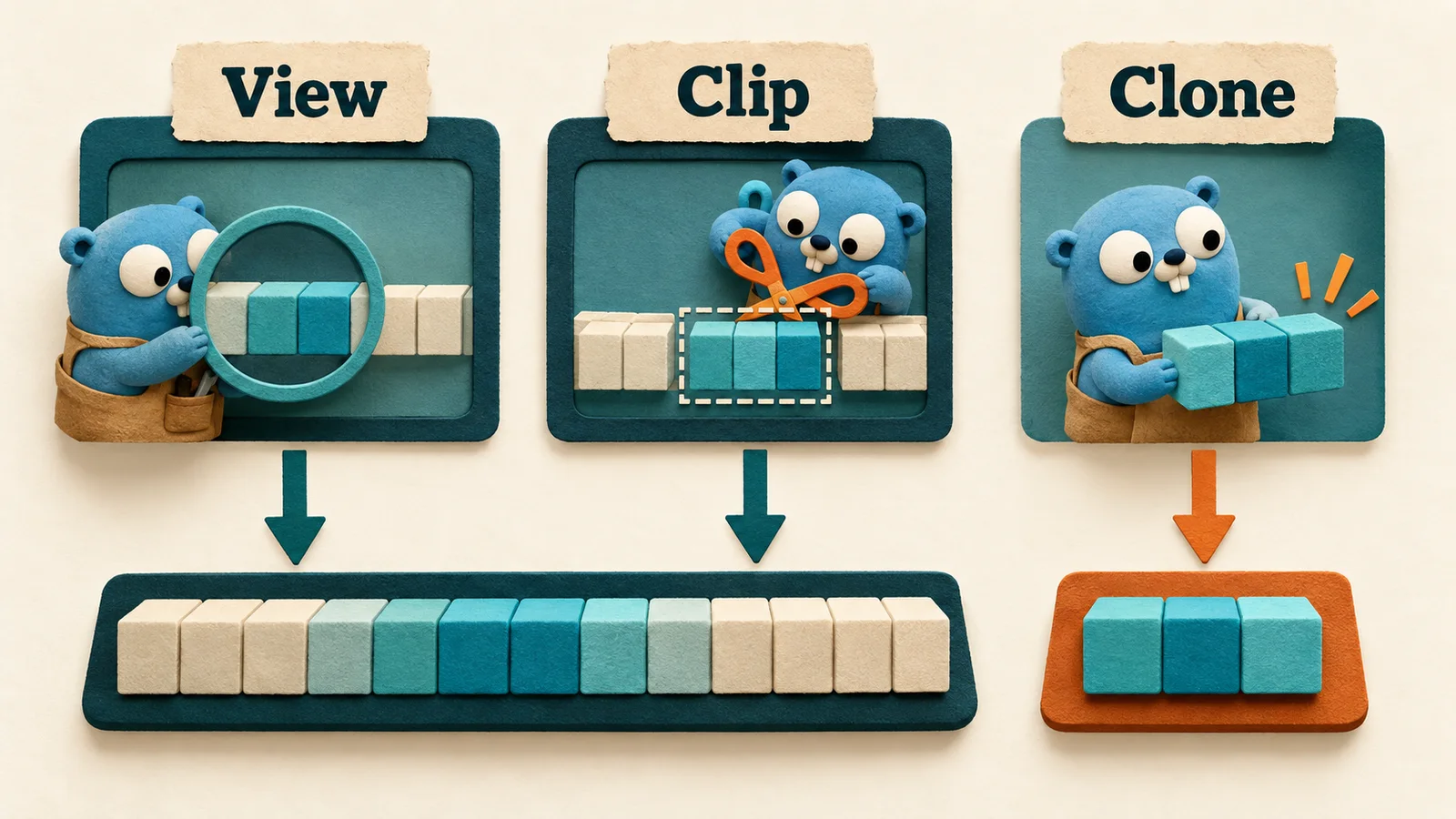
A full slice expression can cap a view at its current length. slices.Clip provides a readable spelling for that operation. Neither spelling copies the elements. Use this when append isolation is the requirement, and use a copy when storage isolation is the requirement.
package main

import (
    "fmt"
    "slices"
)

func main() {
    source := []int{1, 2, 3, 4}
    view := slices.Clip(source[:2])
    view[0] = 7
    grown := append(view, 8)
    grown[1] = 6
    fmt.Println(source)
    fmt.Println(grown)
}
The output is [7 2 3 4] and [7 6 8]. The first mutation reaches the shared array. The append needs a new array, after which changing grown[1] no longer changes the source. Notice how ownership changes at a particular operation; the variable name alone does not establish it. Review code in that order instead of assigning one permanent label such as “safe slice” to every value returned by Clip.
The newer gopls analyzer article explains why a tool may suggest Clip for clarity without promising a deep copy. An automated rewrite can improve expression intent while leaving the same aliasing contract in place.
Clone is shallow, and that qualifier matters
For a slice of integers, cloning the elements gives independent integer storage. For a slice of slices, pointers or maps, cloning only the outer sequence leaves the nested objects shared. That is often correct, but the API should say what level it owns.
package main

import (
    "fmt"
    "slices"
)

func main() {
    original := [][]int{{1, 2}, {3, 4}}
    outer := slices.Clone(original)
    outer[0][0] = 9
    deep := make([][]int, len(original))
    for i := range original {
        deep[i] = slices.Clone(original[i])
    }
    deep[0][1] = 8
    fmt.Println(original[0])
    fmt.Println(deep[0])
}
This prints [9 2] followed by [9 8]. The first copy retained the inner slices; the second copied each inner integer sequence. A general deep-copy operation is a domain decision, not merely a utility loop. If an element includes a mutex, a file handle, a cyclic graph or identity-sensitive object, blindly copying fields can violate invariants. Prefer a constructor or domain-specific snapshot operation that documents which objects remain shared.
For byte payloads, a dedicated copy is usually straightforward. For a request structure containing both metadata and payloads, identify the mutable members individually. Copying everything indiscriminately can add expensive allocations while still failing to copy one referenced object that actually needed isolation.
A tiny view can retain a large allocation
Imagine reading a large response, selecting a short identifier and keeping the identifier in a long-lived map. If that identifier is a slice into the original allocation, the map can keep the large backing array reachable. Reducing the slice's length or capacity does not move those bytes to a smaller allocation. A separate owned copy is the operation that can break that relationship.
This is where two reasonable optimizations collide. Avoiding a copy makes the parser fast in isolation. Retaining a large allocation makes the application expensive over time. Neither statement is universally right. Compare the lifetime of the input to the lifetime of the result, then measure retained memory under a representative workload. A short-lived parser result consumed before the next read needs a different policy from a cache entry retained for hours.
Our retained buffers lesson develops this scenario, while the allocation analysis separates allocation rate from live memory. A heap profile showing large retained objects does not automatically mean that your program needs a pool. It may mean that a small copy at a lifetime boundary is missing.

Channels transfer descriptors unless you transfer ownership
Sending a slice through a channel copies the slice value. It does not freeze the array. A producer that sends a buffer and immediately overwrites it can corrupt a consumer's result. A buffered channel can make this particularly confusing because a successful send only means the descriptor was accepted into the channel, not that the consumer finished reading every element.
There are three defensible designs. Copy the payload before sending. Transfer exclusive ownership and require the producer to stop using that buffer. Or add a completion protocol that returns the buffer only after consumption. Choose one and make it visible in function names, comments and tests. A channel itself does not choose for you.
Cancellation complicates the last design. If the consumer exits early, somebody still needs to decide whether the buffer is reusable, discarded or returned. Review the abandoned path alongside the happy path. The borrowed-buffer and pool guide takes this ownership problem through an explicit release boundary. The concurrent slice lesson covers separate index ownership and collection patterns.
Build a test matrix around boundaries
Test inputs with zero length, one element, spare capacity, exact capacity and nested references. These cases reveal different contracts. A test that only passes a freshly allocated full slice may accidentally force append to allocate, hiding a bug that appears when a caller provides spare capacity. Conversely, a test that expects aliasing after a capacity-growing append is testing an invalid assumption.
For an API that promises an independent result, test both directions: changing the input must not change the result, and changing the result must not change the input. For nested structures, explicitly state which level is independent and test that level. Include nil and empty inputs when their distinction is part of serialization or domain behavior, rather than assuming every clone operation has identical nil semantics.
Run the race detector for code that shares slices between goroutines, but remember that it observes exercised executions. A clean run does not prove that the ownership protocol is sound. Keep a deterministic single-goroutine mutation test as well: temporal aliasing can be wrong without being concurrent. The Go race detector guide explains how to run the tool and interpret its scope.
Review the API before tuning the allocation
A useful API comment answers four questions in plain language: does the function retain input, may the caller mutate it after return, does the result share storage, and how long is a borrowed result valid? These answers eliminate more uncertainty than a comment saying “efficient implementation.” They also let a later maintainer replace an implementation without accidentally changing the ownership contract.
When performance matters, measure the exact boundary you intend to optimize. Count allocations, inspect live memory, and check latency under realistic concurrency. A copy that adds one allocation may release a large backing array much earlier. A zero-copy interface may be excellent inside a tightly controlled parser and unsuitable as a public cache API. The correct choice follows lifetime and ownership, then measurement.
For interview preparation, explain the overlapping-window program aloud before discussing optimization. Then change one line to Clip and explain which mutation still aliases. Finally clone a nested slice and identify what remains shared. These exercises test a reusable mental model rather than a memorized output. Continue with the course map or Go interview preparation, and use the diagrams as prompts to draw your own storage relationships.
Nil, empty and absent are API choices
An empty sequence and an absent value can mean different things at a serialization boundary. In the standard encoding/json package, a nil slice and a non-nil empty slice do not necessarily produce the same JSON representation: an ordinary nil slice marshals as null, while an ordinary non-nil empty slice marshals as an empty array. Byte slices have their own JSON encoding rules, so do not generalize an integer-slice example to every possible payload type. Custom marshaling and field options can change the surrounding contract as well.
The practical lesson is to decide what the consumer expects before normalizing every slice. A collection endpoint may promise an array even when there are no records. A patch request may need to distinguish an omitted field from an explicit empty replacement. Those decisions belong in the boundary model and tests, not in an accidental consequence of which helper allocated a result. A pointer, an explicit presence flag or a dedicated request type may be needed when the domain has more states than a bare slice can represent.
Test the public representation with the actual encoder and model. Include nil, empty and non-empty values, plus any field options or custom marshaler used in production. Do not infer the JSON contract from the visual appearance of a Go value in a debugger. Two values that both print like an empty collection can still cross an API boundary differently. This is another reason to keep ownership, length and semantic absence as separate questions.
Review a parser-to-cache boundary step by step
Imagine a parser returning identifiers from a large input buffer. First, label the parser's result as borrowed or owned in its API comment. Second, identify every consumer that retains the result after parsing returns. A cache, background worker and retry queue are all retention boundaries even when the initial function call is synchronous. Third, place a copy at the first boundary that requires independence, rather than adding copies randomly inside every helper.
Now test the contract without a network or a timing assumption. Supply an input with spare capacity, obtain the identifier, change the original bytes and inspect the cached result. Reverse the mutation direction too. If the result contains nested slices or pointers, decide which level must be independent and write that expectation explicitly. A test that only compares two values immediately after parsing will miss the lifetime problem because both views still contain the same bytes at that moment.
Finally, measure a realistic batch in which a small number of large inputs produce many long-lived short results. Compare both allocation activity and retained memory. A small copy may increase one metric while improving the other, so report them separately. If the input is immutable and already retained for the entire cache lifetime, sharing may be reasonable; document that ownership relationship instead of treating all aliasing as inherently wrong. The review ends when the lifetime contract is clear and supported by evidence, not when every slice has been cloned.
Primary sources & editorial method
We checked these primary references on 23 October 2026. Release facts are attributed; recommended workflows and examples are GopherForge analysis. Illustrations are conceptual, not vendor screenshots or benchmarks.