GopherForge · 9 MIN READ
GopherForge expands: a Go learning path you can return to
Inside our expanded Go course, interview preparation, coding-agent guides and Continue workflow, with a clear distinction between web, App Store and TestFlight availability.
Event: · Reporting and practical analysis. Sources listed below.
A larger library needs a smaller next step
A learning library can grow faster than a learner’s ability to navigate it. That is the problem behind this GopherForge update. More material helps only when a returning reader can recover the context of the last session, understand what the next exercise is testing, and find a related explanation without starting the search again. The expansion brings the Go course, architecture discussions, production tooling and interview preparation into a more connected path. Continue is the small piece of navigation that makes that larger collection manageable.
As of 20 October 2026, GopherForge 1.1.4 is the public App Store release. Version 1.1.5, build 40, adds the latest native Continue work and is in TestFlight and waiting for App Review. These are different availability states. A feature demonstrated in the beta should not be mistaken for a feature already delivered to every App Store customer. The version history records that distinction. The corresponding web learning and Continue experience is available without an account.
This article explains the learning workflow and its limits. It is our product update, written by GopherForge, rather than an independent review or a promise that one application replaces a complete development environment.
What is now in the course
The shared catalog contains 191 course items across 21 units: 169 teaching lessons and exercises plus 22 prediction challenges. There are 122 longer readings. The separate Interview area contains 88 worked preparation guides across 12 topics, with four levels of difficulty. Eight interactive algorithm labs include 24 scenarios and 111 computed steps. Those numbers describe the current catalog; they do not mean that reading every page is the right first milestone for every learner.
Start with Learn Go if you need to build a mental model of values, control flow, slices, interfaces and concurrency. Use the Interview map when you want to practise explaining a constraint aloud. Use the architecture material when a working program has become difficult to change. Each route has a different job, and it is reasonable to move between them as a practical question arises.
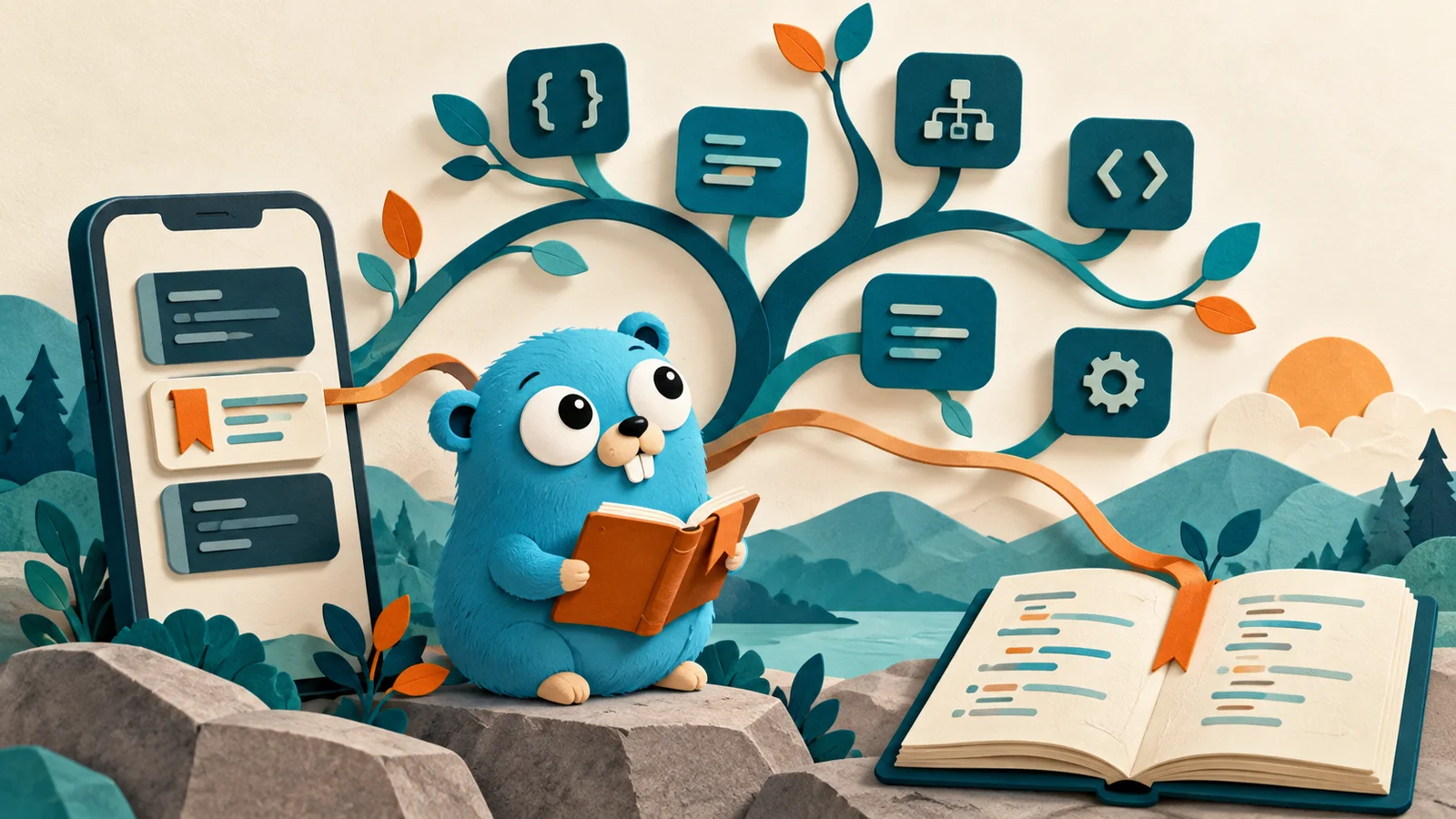
The map presents related ideas as branches. A branch is useful because it supplies context: a lesson on ownership belongs near the operations that acquire, share and release a resource. A flat list can tell you that a page exists, but a visible relationship helps explain why you might need it next.
Learn, predict, run, explain
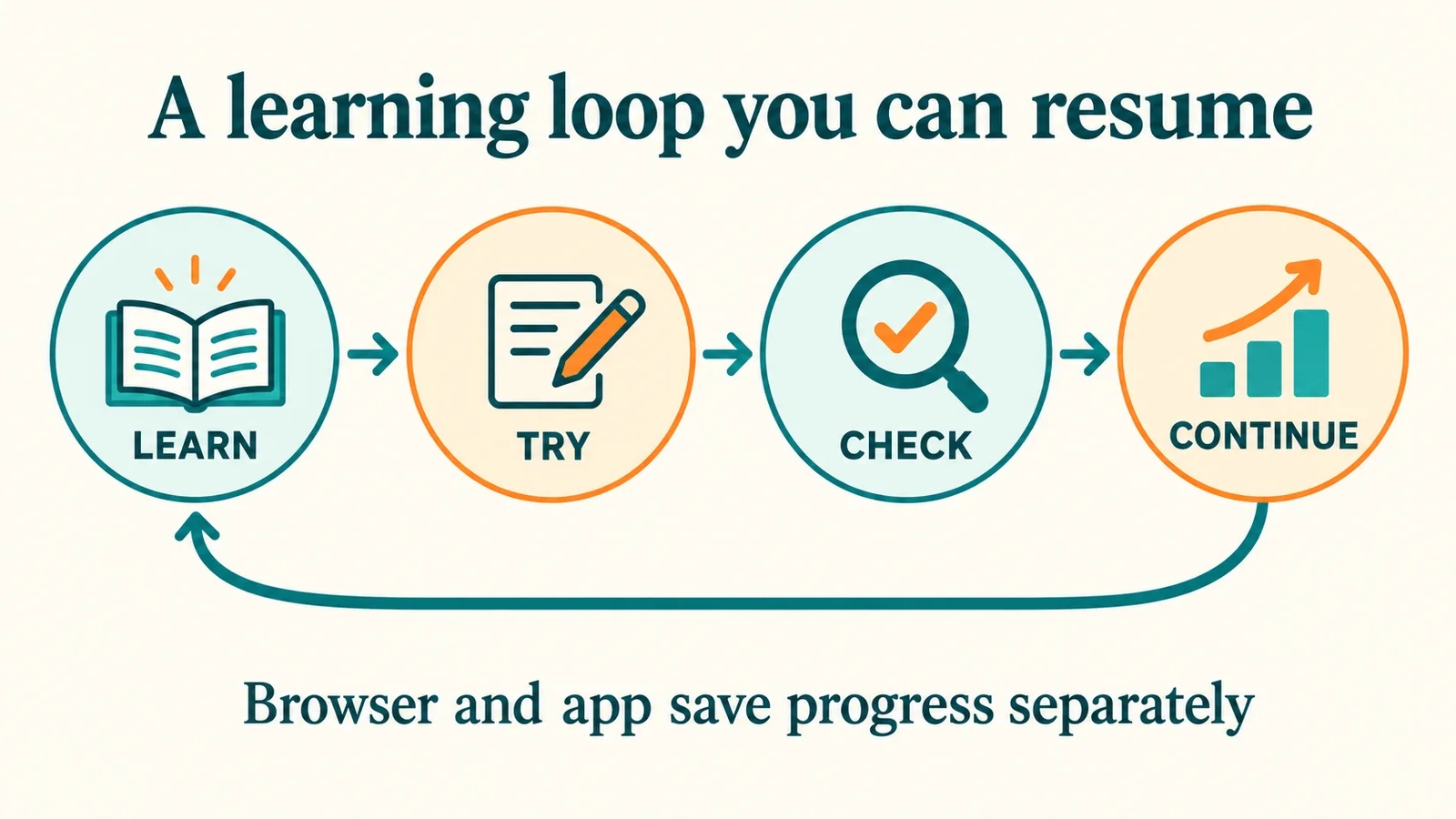
A productive session can be short. Read one explanation, predict a result before running the program, then compare the observed result with the model you wrote down. Finally, explain the difference in your own words. The explanation is the part that turns a successful run into something you can reuse when the input changes.
Consider a slice exercise. Printing a length and capacity once is easy. Explaining why appending a value may change the backing array requires reasoning about ownership, aliases and the operation being performed. Change one assumption after the first successful run: keep a second slice that shares the array, append through the first, then observe which values are still shared. The lesson becomes a small experiment rather than a memorised output.
The same pattern works for error handling. Write the expected failure first. Decide what information the caller needs and what detail belongs in a log. Run a failing case, inspect the error chain, and then explain whether retrying is safe. A green check is useful evidence, but the ability to transfer the reasoning to a changed constraint is the real learning objective.
Continue restores a place, not a claim of mastery
On the web, the study bookmark records the last course lesson or interview guide and the relevant section. It is stored in the current browser. The home page and study maps can therefore offer a concrete Continue link, rather than asking the reader to remember an identifier or scroll through a long catalog. Existing completion and self-assessment state remains separate from the bookmark.
That separation matters. Opening a lesson should not silently mark it as understood. Reaching the bottom should not imply that code compiled successfully. A bookmark says where you were; an assessment says what you believe you can explain; a compiler result says what a specific program did. Keeping these meanings distinct helps avoid a reassuring progress indicator that hides unfinished work.
The native application also persists learning progress and the last study destination locally. Version 1.1.5 makes returning to that destination easier. Web progress and native progress currently remain independent. There is no account-based synchronisation between the browser and the app. Clearing browser storage, using another browser profile or reinstalling without restoring local data can change what is available to Continue.
Interview preparation should expose the reasoning
An interview answer is rarely improved by adding more terminology. It improves when the candidate identifies the constraint, states an assumption and works through a boundary case. The Interview preparation area is organised around that process. A guide includes the question, a strong answer, a common trap, an exercise, a worked solution and a follow-up that changes the original conditions.
For an algorithm question, step through a small input before discussing complexity. If a sliding window shrinks, identify the invariant that requires it to shrink. If a breadth-first traversal uses a queue, explain what is enqueued and why a node is not processed repeatedly. The interactive traces are there to make state changes visible, not to animate a conclusion that the reader must accept on trust.
After understanding an example, choose a counterexample: an empty input, repeated values, a disconnected graph, a missing key or a cancelled request. Interview preparation becomes more useful when a reader learns to ask these questions without a prompt. A worked answer is a starting point for that habit, not a script that should be recited unchanged.
Coding agents belong in the engineering workflow
Eight guides address Go work with coding agents, including Codex, Claude and Cursor. They cover workflow design, API validation, security, concurrency review and honest interview practice. Start with the agent workflow guide, then compare the guides for Codex, Claude and Cursor. The material is about reviewing generated changes in a Go repository, not about treating a particular model as an authority on your dependency versions.
A useful task for an agent has a bounded objective and an observable result. Ask for a table-driven test around a failing case, a small refactor with unchanged behaviour, or an explanation of a race that points to the ownership of shared data. Provide the pinned toolchain and module versions. Require the agent to distinguish a test it actually ran from a test it merely recommends.
Review generated code at the boundaries. Does a goroutine stop when its parent request is cancelled? Is a database client shared for the intended lifetime? Does a retry duplicate a side effect? Does an API exist in the version recorded in go.mod? These are ordinary engineering questions, and generated code needs the same answers as code written manually.

Around Go connects code to its environment
Production behaviour often depends on a boundary outside a function. A database pool limits concurrent work. A container has a memory budget. Kubernetes may send a termination signal while requests are active. A module proxy can be unavailable during a build. Around Go connects those operational questions to the code that must respond to them.
The expanded material includes MongoDB and Redis, Docker and Kubernetes, shell commands, modules and tooling. MongoDB discussions cover shared clients, indexes, atomic writes, transaction retries, cursor ownership and saturation. Redis discussions cover bounded clients, cache-aside, pipelines, leases, consumer groups and memory pressure. The emphasis is on consequences: what can time out, what can be repeated, and what consumes a scarce resource while waiting.
These topics are best studied alongside a concrete failure. For example, an otherwise correct request handler can become unreliable when it starts more work than a connection pool can serve. Measure where time is spent before increasing a limit. The course map lets readers move from a symptom into the surrounding operational concepts without pretending that a single command fixes every deployment.
The native workbench has explicit boundaries
GopherForge includes an offline native Go workbench. The bundled toolchain in this release is Go 1.27.1; this announcement does not claim that the app already embeds the newer Go 1.27.3 patch. Our separate security update analysis discusses why runtime versions and rebuilt artifacts need to be tracked independently. A mobile release has its own build and review lifecycle.
The workbench uses a WASI environment with documented restrictions. It does not provide cgo, general guest networking or an unrestricted shell. Package loading also has resource limits. In particular, a module containing more than 4,000 retained files can be rejected even when the module is valid Go code. A dependency with thousands of platform-specific files may therefore behave differently here from a desktop installation.
The package limits reference explains the practical boundary. A failed import should be a clear diagnostic, not a hidden condition that leaves the learner guessing. For networking services, native integrations or unusually large dependency graphs, use an appropriate desktop or server environment and carry the same reasoning and tests across.
Pricing, access and the right starting point
The web lessons and preparation guides are freely readable without registration. The native app is a one-time paid purchase, listed at $6.99 USD in the US storefront; local prices and taxes can differ. There is no subscription required to read the web course. Check the App Store listing for the price and availability in your region.
Choose a starting point that matches the question in front of you. New to the language? Read a Go core branch and run the smallest example. Preparing for an interview? Pick one guide and explain it without looking at the worked answer. Maintaining a service? Begin with the resource or failure boundary you are investigating. Interested in editor changes? Read our VS Code update analysis and the gopls refactoring discussion.
A useful learning tool reduces the distance between confusion and the next experiment. The expansion gives that experiment more context; Continue makes it easier to resume. The aim is a library that remains usable as it grows, with clear availability, honest progress and examples that help you understand a program you will have to maintain yourself.
Primary sources & editorial method
We checked these primary references on 20 October 2026. Release facts are attributed; recommended workflows and examples are GopherForge analysis. Illustrations are conceptual, not vendor screenshots or benchmarks.