Tooling · 9 MIN READ
Go for VS Code 0.58.0: upgrade the editor without losing the contract
The official Go extension gains LSP 3.18 support and changes to diagnostics, interface stubs and struct tags. A practical guide to reviewing the upgrade in a Go repository.
Event: · Reporting and practical analysis. Sources listed below.

The release and the boundary it changes
The official Go extension for Visual Studio Code released version 0.58.0 on 20 October 2026. Its release notes list support for LSP 3.18, more precise diagnostic deduplication, interactive interface-stub generation and changed struct-tag prompts. Windows attach-process discovery also moves away from deprecated wmic. These are editor integration changes, so an upgrade deserves a quick workflow check even when your application source has not changed.
Diagnostic deduplication now considers the starting column as well as the starting line and severity. Generate Interface Stubs uses gopls interactive refactoring, while a legacy command remains available. Struct-tag commands prompt unless configuration supplies the choices; the previous default json,omitempty behaviour is removed. Removing tags no longer means removing every tag by default. Trace logging also needs the appropriate channel level and server trace setting. See the release notes for the exact configuration names.
The rest of this article is our recommended validation workflow and original examples. The practical question is how an editor-generated change crosses an application boundary, especially when the change is small enough to look harmless in a diff.
Record the stack before diagnosing it
A Go editing session involves several versions. The editor hosts an extension, the extension communicates with gopls, and gopls loads a module with a selected Go toolchain. Tests may run locally, in a container or in CI. When one of these layers changes, symptoms can look like a source-code problem even when the disagreement is between environments.
Before upgrading a team workspace, record the current extension version, gopls version and output of go version. Read go.mod and any workspace configuration. Identify whether the editor and terminal operate in the same directory and whether a remote development environment has its own tools. This is a small inventory, but it makes a report such as “the editor reports an error that CI does not” reproducible.
After the upgrade, open a representative package and let loading complete. Compare one diagnostic with the command-line result rather than clearing every cache at once. If the command line and editor disagree, isolate the selected module, build tags and toolchain first. Changing multiple settings simultaneously destroys the evidence needed to understand which layer was responsible.
More diagnostics do not always mean more failures
A diagnostic points to a location and a concern. Two concerns on the same line can still be distinct if they point to different expressions. A user who has learned to interpret a line-level marker as a single problem may therefore notice a different presentation after an editor upgrade. The correct response is to inspect the locations and messages before concluding that the compiler has become stricter.
Try a deliberately small example with several expressions on one line. Expand it into separate lines and compare the messages. Then fix one expression and observe which diagnostic disappears. This exercise separates presentation from program semantics. It also helps when an agent is using editor diagnostics as feedback: the agent should preserve the message and location instead of reporting only an aggregate count.
Do not measure source quality by the number of visible markers alone. A missing diagnostic can be a presentation problem, while an extra diagnostic can be newly visible evidence of an existing problem. The meaningful check is whether the actual program compiles and whether the relevant tests express the behaviour you intend.
Struct tags are an external data contract
A struct tag can affect JSON names and omission rules. That makes a generated tag a change to an external representation, even if no function body changes. Imagine an API where a client distinguishes an absent field from a field explicitly set to zero. Adding an omission option without checking the wire format can silently change what the client receives.
Use a tiny contract test around the exact value that matters. Test an empty value, a nonempty value and a value whose zero representation has business meaning. Compare the encoded bytes or decode into a representation that preserves the distinction you need. Do not use a broad snapshot that reviewers habitually approve without reading; make the intended names and presence rules visible in the assertion.
package contract

import (
    "encoding/json"
    "testing"
)

func TestAttemptCountRemainsPresent(t *testing.T) {
    type Reply struct {
        Attempts int `json:"attempts"`
    }
    got, err := json.Marshal(Reply{})
    if err != nil { t.Fatal(err) }
    if string(got) != `{"attempts":0}` {
        t.Fatalf("wire contract changed: %s", got)
    }
}
This is an illustrative complete test. Its purpose is to make a zero-value contract explicit, not to prescribe the right omission rule for every API.
Review tags by consumer, not just by field
The same struct may be read by more than one library. JSON encoding, a database driver, configuration loading and validation can each interpret their own tag namespace. A bulk edit should therefore start by identifying the consumer of each tag. Deleting a database tag while intending to change JSON can alter persistence behaviour even if HTTP tests still pass.
Prefer separate transport and persistence types when their contracts are genuinely different. That is an architectural choice with a maintenance cost, so do not create duplicate types merely to satisfy a style rule. Instead, make the mapping visible at the boundary and test the transformations that protect compatibility. The architecture course discusses why a boundary is useful only when it reduces a concrete form of coupling.
For a tag removal command, inspect the resulting diff before running another refactor. Confirm the namespace you intended to remove, search for custom marshaling and consider embedded fields. A generated edit is quick to produce; reviewing the consumers is what prevents that speed from becoming a compatibility incident.
A generated interface stub is unfinished behaviour
An interface implementation has two separate properties: its method set can satisfy the compiler, and its method bodies can honour the contract. Generating stubs helps with the first property. It does not decide ownership, cancellation, retries, transaction semantics or the meaning of an empty result. Review the implementation with those questions in mind before treating a successful compile as completion.
A small interface defined by a consumer is often easier to test than a broad interface copied from an implementation. Start with the operation the caller actually needs. Write a test for a successful response and a test for the failure the caller must handle. Then implement only that contract. If a generated method panics or returns a placeholder value, keep the task visibly unfinished until that behaviour is replaced.
This is especially relevant when working with a coding agent. Ask the agent to identify generated placeholders and explain which tests cover each method. The API validation guide applies the same discipline to methods invented from memory: verify the pinned dependency and inspect the actual signature before writing an implementation around it.

Validate one workflow end to end
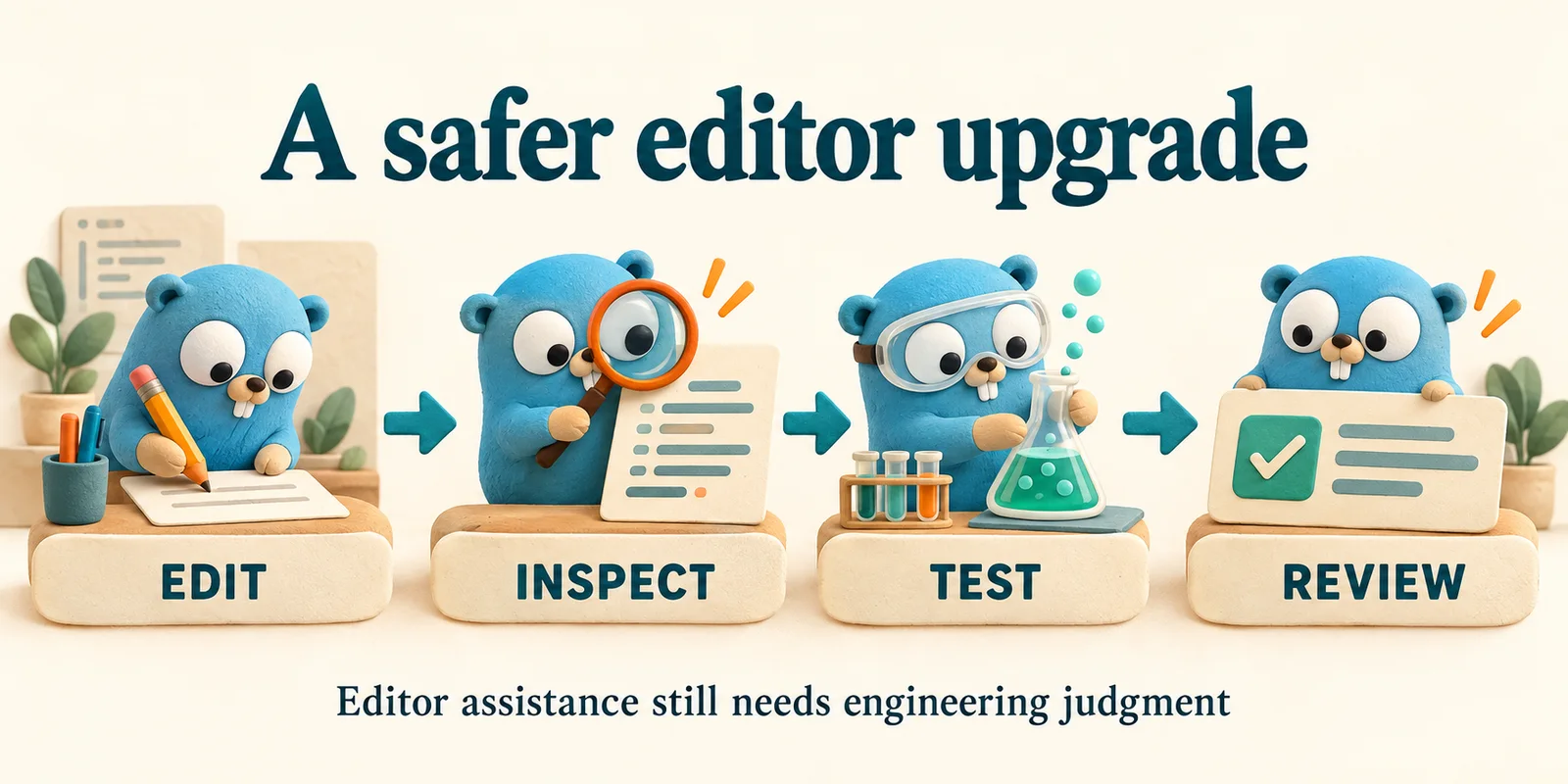
Pick a familiar package for a small upgrade rehearsal. Introduce a temporary local mistake, observe the diagnostic, correct it, run a focused test and inspect the diff. Next, invoke a code action on a disposable branch and undo it after reviewing the output. This checks the complete editor loop without turning the production codebase into a test fixture.
Use commands appropriate to the repository. A focused package test gives fast feedback; the wider required test gate checks integration. Where supported, the race detector can expose an exercised data race, but a passing race run does not prove the absence of all concurrency defects. The Go testing documentation explains the test harness, while repository instructions should define the required scope.
Keep generated files and source changes separate when that makes review easier. If upgrading a tool rewrites many unrelated files, stop and find the reason before accepting the bulk change. A small editor upgrade should not become an accidental migration of formatting, APIs and dependencies in the same unreviewable commit.
Use traces to answer a specific question
Verbose language-server traces can help diagnose a missing code action or an unexpected response, but they should answer a bounded question. First write down what you expected the editor to request and what happened instead. Reproduce the problem with the smallest useful file, then collect the trace around that action. An endless log from a busy workspace is difficult to interpret.
Review traces before sharing them. File paths, source fragments and workspace details may be present. Keep the time window short and avoid publishing a raw session from a private repository. If you can reproduce the problem in a public minimal module, the report becomes safer to share and easier for maintainers to investigate.
Once the issue is understood, restore ordinary logging. Diagnostic settings are part of the environment you maintain, not an extra feature that must stay enabled forever. Record the tool versions with the report so that a future reader can distinguish a fixed issue from a configuration mismatch.
Upgrade automation needs an observable result
Teams increasingly ask agents to update editor and tooling configuration. Give that work a concrete acceptance criterion: a known package loads, a specific refactor is available, a focused test passes and no unintended source change remains. Require a record of which commands actually ran. A plan to run tests is not evidence that the upgrade works.
The coding-agent workflow recommends bounding both the task and the review surface. An agent can assemble the version inventory and propose the smallest configuration change, while a reviewer checks the external contract. If the task touches JSON tags, the review should include encoded output; if it touches concurrency, the review should include ownership and cancellation.
Do not make an editor extension responsible for runtime safety. The editor can expose information and automate syntax-aware operations. The application still needs explicit invariants, tests and deployment checks. That distinction keeps a productive tool useful without giving it authority over decisions it cannot observe.
A practical acceptance checklist
Before finishing the upgrade, confirm the selected toolchain and language server, open the intended module and compare one diagnostic with the command line. Exercise a code action in a reversible change. Inspect generated tags and method bodies. Run the repository’s required tests and read the final diff. Record any configuration that deliberately preserves an older workflow.
For further study, read our interactive refactoring analysis, then practise explaining a small interface in Interview. If the upgrade exposes a dependency or toolchain mismatch, the security maintenance workflow provides a complementary inventory approach. These are connected skills: knowing where an edit was generated, what contract it changes and how that change reaches a running program.
The useful outcome of an editor release is a clearer engineering loop. You should be able to make a change, inspect the evidence, test the behaviour and explain the result. Version 0.58.0 supplies new integration behaviour; the review process turns that behaviour into a dependable daily workflow.
Primary sources & editorial method
We checked these primary references on 20 October 2026. Release facts are attributed; recommended workflows and examples are GopherForge analysis. Illustrations are conceptual, not vendor screenshots or benchmarks.