COMPILER & PERFORMANCE · 10 MIN READ
Go 1.27 experimental SIMD: a measured path across amd64, arm64 and wasm
Go’s expanded experimental SIMD support, with a practical adoption plan: scalar references, CPU features, tail cases, target tests and representative benchmarks.
Event: · Reporting and practical analysis. Sources listed below.

Experimental SIMD gets a wider hardware story
On 2 October 2026, the Go team described the expanded architecture-specific SIMD work in Go 1.27. The experimental simd/archsimd package now includes support for amd64, arm64 and wasm, enabled with GOEXPERIMENT=simd. That makes the experiment relevant to more development machines and deployment targets, but it remains an experiment with a hardware-dependent API surface.
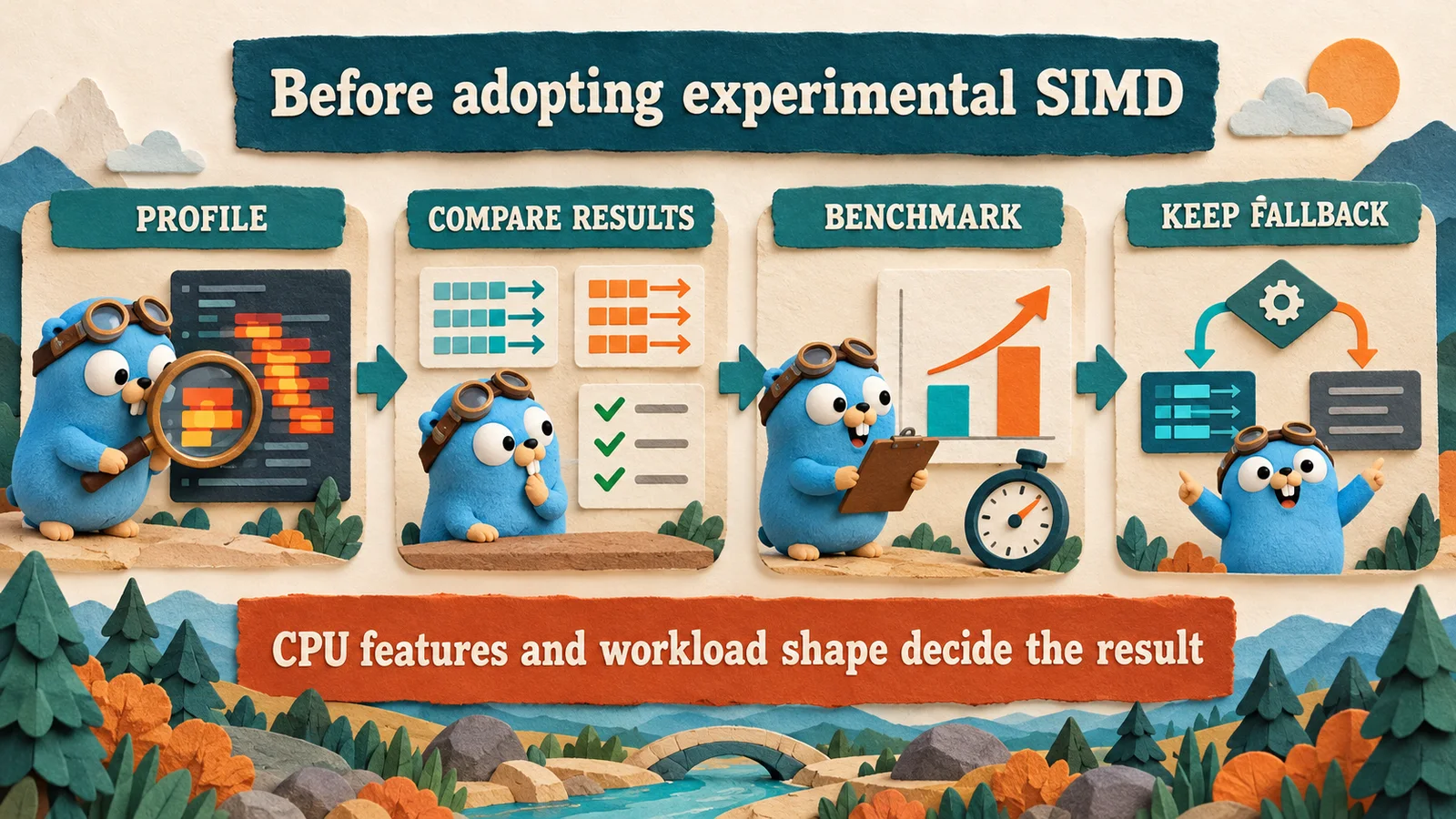
The announcement is an invitation to evaluate a tool, not a reason to rewrite ordinary Go loops automatically. The official architecture-specific SIMD article documents the release facts and supported operations. Our practical question is narrower: if your service has a genuine data-processing hotspot, what evidence would justify adding an experimental implementation? The answer should include a clear contract, a scalar reference, correctness checks, target coverage and a maintenance plan. A faster demonstration on one workstation is only one piece of that decision. The rest of the article develops a review process a small Go team can actually carry out.
Find the operation that dominates real work
Start with a profile from the workload you intend to improve. A loop that looks repetitive in source may account for very little of the service’s CPU time. The expensive part might instead be parsing, allocating, copying or waiting on another system. Optimizing the most visually obvious loop is a common way to create maintenance work without changing the experience of a single user.
Consider a service that scans byte buffers for a small set of delimiter values. Before exploring vector instructions, define where those buffers come from, how long they usually are and what fraction of the request the scan consumes. Include empty and unusually large inputs in the description. Record whether the input is already in memory or must first be decoded from another representation.
Then write a prediction. For example, the team may expect a faster scan to help large in-memory batches while having little effect on small requests. A prediction makes the experiment falsifiable. If the profile or benchmark contradicts it, the team has learned something useful without needing to defend a fashionable technique. The Go diagnostics guide is a primary reference for choosing profiling tools; the experiment itself should reflect your application’s workload.
Write the contract in plain language
A performance implementation must preserve the operation’s meaning. For the delimiter scan, does the function return a count, the first matching position or all positions? Does it treat input as raw bytes or text? Are results allowed to depend on architecture? What happens when no element matches? These questions should be answered before an optimized implementation appears in review.
For arithmetic operations, add questions about overflow, floating-point behavior and the order of reduction. A result that is acceptable in a graphics effect may be unacceptable in financial reporting. Do not let a benchmark define the contract accidentally by testing only convenient values. The contract belongs to the application and its users.
Keep that contract close to the scalar implementation and the test fixtures. Reviewers should not need to reconstruct it from vector operations. This is also a useful architecture boundary: callers depend on a small ordinary Go function, while the implementation can change behind it. The architecture course direction discusses this kind of boundary in a broader context. Here the benefit is immediate: one explicit contract gives every implementation the same target, and gives the team a straightforward way to explain why a faster result is still the right result.
Preserve a boring scalar reference
A small scalar function is valuable even when the optimized path is much faster. It can serve as a readable reference, a fallback and a test oracle for representative inputs. For a byte-counting example, the contract can be deliberately simple:
func countByte(src []byte, want byte) int {
    count := 0
    for _, value := range src {
        if value == want {
            count++
        }
    }
    return count
}
This fragment is a baseline, not an SIMD implementation and not a claim that it needs replacing. Compare any experimental version against it across empty slices, short slices, repeated values and inputs with no matches. Include data where matches occur near the beginning and end. When vector processing handles a wide chunk at a time, the leftover tail still has to obey the same contract.
Keep the reference in a form reviewers can understand without hardware expertise. If both the reference and optimized versions share the same complicated helper, they can share the same mistake. Independent clarity is useful here. A performance test tells you how long one implementation took; a reference comparison helps determine whether both implementations did the same work. Neither measurement replaces the other, and a release decision should retain evidence for both.
Treat target support as a product requirement
The development machine is not the deployment fleet. List the architectures and environments the application actually supports, including older machines, containers and any WebAssembly runtime. An architecture name alone may not describe every optional CPU feature available at runtime. The official experimental documentation explains the relevant feature checks; use those checks rather than assuming that a successful build proves an instruction is safe everywhere.
Make the dispatch decision visible in the implementation design. The ordinary function should still have a defined behavior when the optimized path is unavailable. Keep that fallback tested instead of allowing it to become an unmaintained branch that only runs during an incident on older hardware.
Also separate compilation from execution. A cross-compiled target demonstrates that source can be built for that configuration; it does not demonstrate correct execution or useful performance on the target machine. Record which tests actually ran and where. For a WebAssembly application, the selected runtime and its feature support are part of the test environment. This is particularly relevant to GopherForge: experimental upstream wasm support does not establish that our bundled toolchain and runtime expose the same feature. Check the documented application limits before assuming an upstream experiment is available inside the native workbench.
Benchmark a distribution of input sizes
A single large buffer can hide the costs that matter in ordinary traffic. Define a small set of representative sizes from observed or intentionally modeled input. Include cases smaller than the vector width, exact-width cases and cases with a tail. Keep the input generation outside the timed region when that generation is not part of the operation you are evaluating.
Use a repeatable benchmark procedure and retain the environment description with the results. Compare repeated runs rather than choosing the most flattering sample. If a service runs under a constrained CPU budget, test under a representative constraint as well as on an idle workstation. The result should help predict the deployment you own, not merely describe a machine with a convenient processor.
The testing package documentation explains Go’s benchmark facilities. Our recommendation is to organize the report around decisions: which input classes benefit, which regress, and how large the benefit must be to justify a second implementation. This article intentionally publishes no speedup number because we have not benchmarked your application. A credible report can conclude that the scalar path is already sufficient. That is a successful experiment when it avoids unnecessary complexity and leaves a reproducible baseline for future work.

Measure the whole request after the inner loop
Suppose the optimized scan is convincingly faster in isolation. Put it back into the request path and measure again. The service may spend most of its time elsewhere, or the new implementation may change memory behavior enough to affect the surrounding work. A local improvement should earn an end-to-end explanation before it becomes a user-facing performance claim.
Keep the old implementation available for a controlled comparison. Compare the same input distribution, application configuration and downstream dependencies. Watch errors and resource use alongside latency. A change that improves one large batch while worsening frequent small requests may still be useful, but the selection rule should follow the workload rather than hide the tradeoff.
This step also helps the team choose between different kinds of optimization. If allocating the input dominates the scan, an allocation or data-layout change may be more valuable than SIMD. Our small-allocation analysis explores that neighboring question. Connect profiles across the request instead of treating each new runtime feature as an independent reason to rewrite code. The application is a chain of work; the useful improvement is the one that changes the part of that chain that users actually wait for.
Isolate the experiment and name its owner
An experimental dependency needs an explicit maintenance decision. Record the toolchain configuration required to build it, the supported targets and the person or team responsible for evaluating future changes. A prototype hidden behind an ordinary package name can become a production obligation before anyone notices that it depends on a changing API.
Keep the experimental implementation small and close to its tests. Avoid letting vector-specific types spread across application interfaces unless that exposure is itself a deliberate library design. Callers should not need to understand an instruction set to ask for a byte count. A narrow boundary makes it easier to update or remove the experiment later.
Write a short exit plan. If the next toolchain changes the API, can the team temporarily return to the scalar implementation? If a target shows a correctness issue, can that path be disabled without changing the public contract? These are ordinary maintenance questions, not reasons to avoid experimentation. They make experimentation safer to adopt because the team knows what it is agreeing to maintain. The clean-code unit is a useful companion: clarity includes showing which complexity belongs to an implementation and which complexity every caller must carry.
Review the evidence as if you were the next maintainer
Ask a reviewer who did not write the prototype to explain its correctness argument. They should be able to identify the input contract, the tail behavior, the dispatch rule and the reference tests. Then ask them to reproduce one representative benchmark. If the result depends on an undocumented local flag, the review has found a concrete improvement to make before release.
Include adversarial examples in the review. What happens with a zero-length input? Which path runs on a machine without the optional instruction? What does the implementation do at a slice boundary? Which arithmetic differences are permitted? A good answer points to a documented rule and a test, rather than saying the code worked on the author’s laptop.
For interview preparation, explain why SIMD and goroutines solve different problems. Multiple workers can divide independent work across tasks; vector operations act on groups of data within an implementation. Combining them without a workload model can add overhead rather than remove it. The algorithm interview guides help practice this style of reasoning: define the invariant, examine the trace, then discuss complexity and machine-level costs without confusing one layer for another.
A sensible next experiment
Choose one measured hotspot and one supported target. Preserve a scalar reference, write the contract, create representative fixtures and run the correctness comparison before the performance comparison. Expand target coverage only when the first experiment produces evidence worth maintaining. Keep the build configuration and results with the change so another engineer can evaluate the next toolchain release.
The October announcement broadens the set of Go developers who can try architecture-specific SIMD. Its practical value will come from careful experiments in libraries and workloads that benefit from parallel data operations. It does not establish that every service needs explicit vectors, nor that an experimental optimization should be exposed throughout an application.
Treat the feature as a candidate behind a stable boundary. If it wins on the workload, survives correctness checks and remains supportable across your targets, you have a useful optimization. If it does not, retain the baseline and the lesson. Both outcomes are better than a sweeping rewrite driven by a release headline. The strongest result is a smaller uncertainty about how your actual Go program behaves.
Primary sources & editorial method
We checked these primary references on 21 October 2026. Release facts are attributed; recommended workflows and examples are GopherForge analysis. Illustrations are conceptual, not vendor screenshots or benchmarks.