COMMUNITY & DEVELOPER EXPERIENCE · 12 MIN READ
Go Developer Survey 2026: turn daily friction into useful feedback
The 2026 Go survey is open. Prepare concrete feedback about modules, editors, agents and debugging with a practical evidence-first workshop.
Edition: · Event: . Sources and worked examples below.
The survey is open; the useful part is your experience
The Go team announced the 2026 Go Developer Survey on 21 October. As of this edition on 23 October, the announced response window runs through 3 November. The invitation estimates ten to twenty minutes, makes every question optional and says results are expected early in 2027. Those are the news facts; there are no 2026 results to interpret yet. The primary announcement is linked below, and its survey link is the appropriate route to participate.
For working developers, the opportunity is broader than expressing a language preference. A concrete account of a confusing module upgrade, an unreliable editor interaction or an expensive debugging session can explain where a development workflow breaks down. This article offers an original preparation workshop for turning that experience into useful feedback. It does not claim that these are official survey questions, that a particular feature is planned, or that submitting an answer guarantees a roadmap outcome.
Start from one real task, not a wishlist
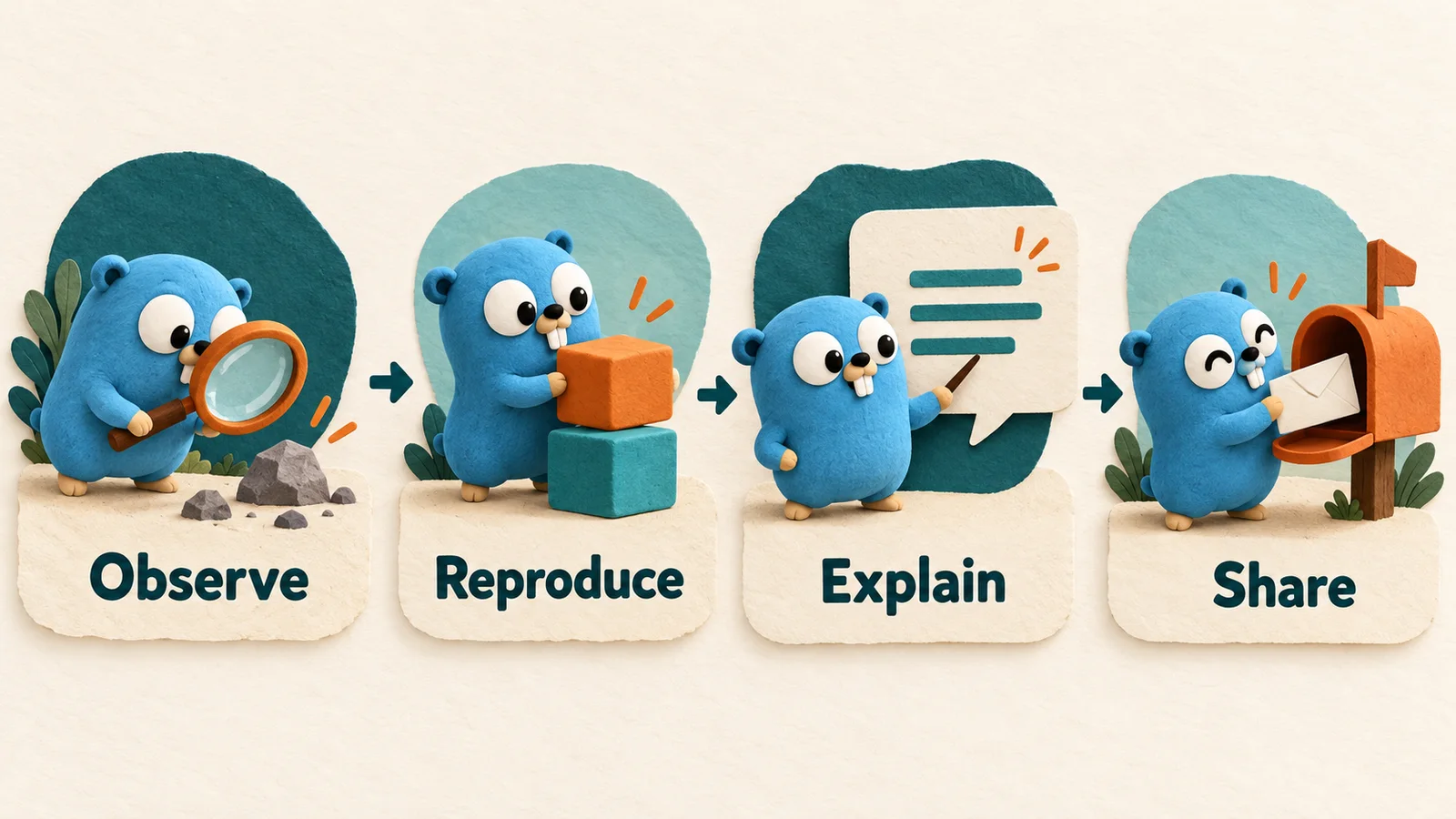
Pick a recent task you actually performed. Perhaps you added a dependency to a private module, traced a cancellation bug, or tried to understand why a small byte slice retained a large allocation. Write down the intended outcome and the first point where progress became difficult. This produces a more precise account than a general statement that tooling should be simpler.
Separate frequency from severity. A small annoyance repeated twenty times a day can have a large cumulative cost. A rare failure that blocks a release can matter for a different reason. Describe both without inventing a numeric estimate you did not measure. If you only know that a task took much longer than expected, say that and explain the observable steps that caused the delay.
A useful private note has four fields: task, environment, obstacle and workaround. Keep it short enough that you can check it against memory or logs. The note is preparation for your own answer, not a template to paste into every survey field. Different questions may ask for different kinds of information, and an optional question can be left unanswered when you lack relevant experience.
Capture the environment without exposing the project
Go behavior depends on more than the version printed by a terminal. A workspace can select a toolchain, an editor can run a separately installed language server, and a container can build with a different configuration from the host. Record the parts relevant to the obstacle before deciding what caused it.
go version
go env GOTOOLCHAIN GOWORK GOPROXY
gopls version
These commands help inventory a local environment. Review their output before sharing it: proxy settings or paths can reveal internal infrastructure. You usually do not need to disclose a private repository name, access token, customer payload or proprietary algorithm to explain a workflow problem. Replace sensitive identifiers with neutral examples while preserving the structural relationship that caused the issue.
For an editor problem, verify which language-server binary the editor actually uses. For a module problem, preserve the relevant module or workspace relationship. Our module lessons explain these boundaries, and the gopls upgrade workshop shows how to compare the editor's executable with the terminal's. Environment evidence helps distinguish a language problem from an installation mismatch.
Separate the symptom from your hypothesis
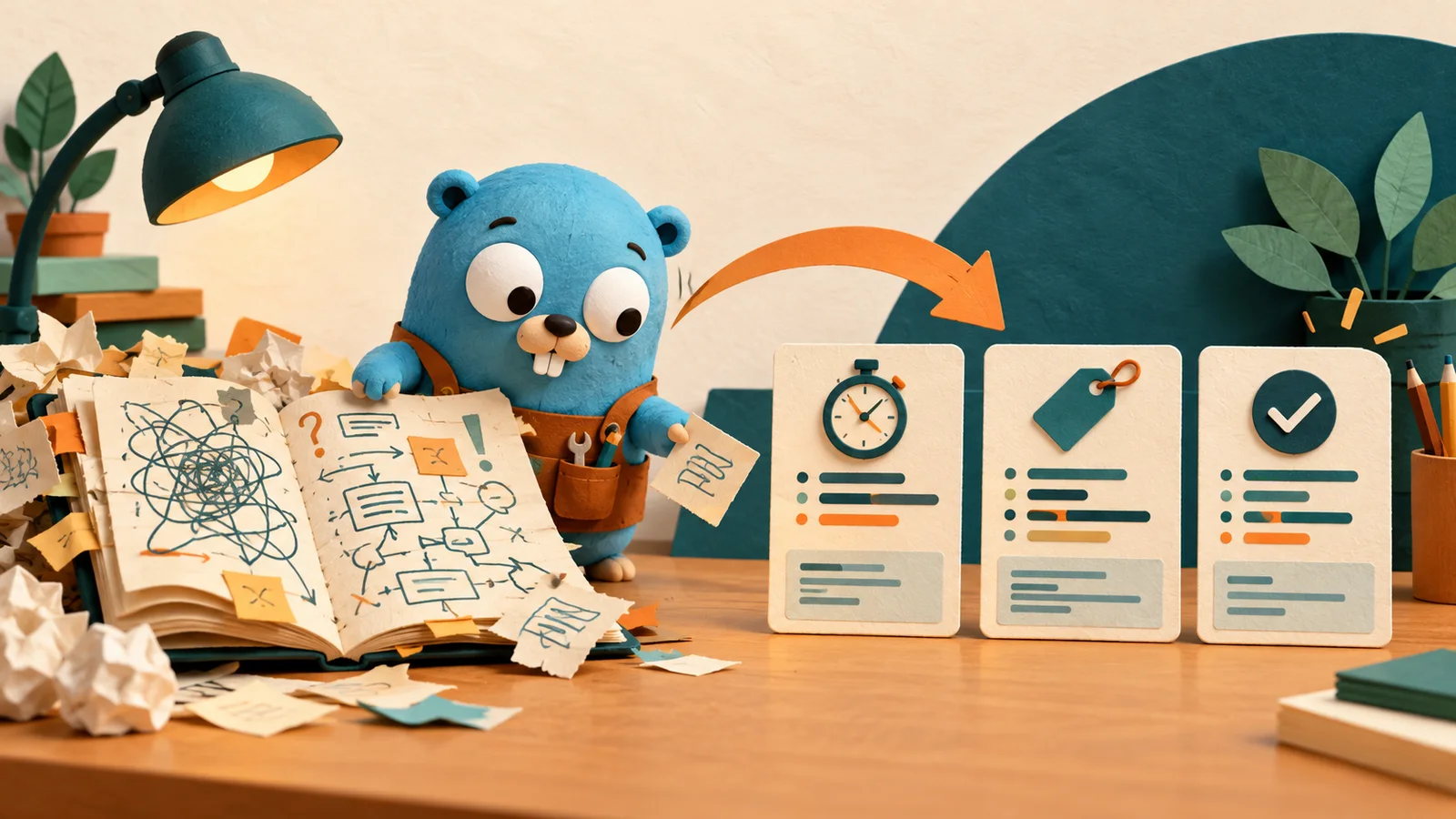
Suppose a request handler's memory grows after large responses. “The garbage collector leaks memory” is a hypothesis. “A cache retains short slices derived from large response buffers” is a more specific observation if a profile and reproducer support it. The difference matters because the right fix may belong in the application's ownership contract rather than in the runtime.
Write the observable symptom first, then label the suspected cause. Include what you tried and what changed. If reducing cache lifetime changed retained memory, that is useful evidence. If you have not isolated the cause, say so. Uncertainty stated clearly is more informative than a confident explanation built from a single graph.
The slice backing-array guide offers a concrete example of this distinction. A small view can keep storage reachable without the runtime violating its contract. That does not make the developer experience irrelevant: the difficulty of discovering ownership can itself be useful feedback. Good reports can acknowledge correct language behavior while describing why the behavior was hard to understand.
Build a small reproducer when the problem is technical
A reproducer should preserve the condition that makes the problem appear and remove unrelated machinery. For a pointer/value error mismatch, a short program may be enough. For a workspace loading issue, reducing everything to one file may remove the very module relationship that matters. Minimal means the smallest faithful case, not automatically the shortest source file.
Use deterministic examples where possible. If the issue involves timing, explain the coordination steps and run count rather than hiding flakiness behind a sleep. If it concerns performance, pin the input, toolchain and measurement method. A before-and-after result without consistent conditions can be an interesting clue, but it is weak evidence for a causal claim.
Surveys and bug reports serve different purposes. The survey can explain the impact on your workflow; a technical issue tracker can carry the focused reproducer and follow-up discussion. Read the appropriate project's contribution guidance before reporting a bug. Do not assume a long pasted stack trace is the best answer to a broad experience question, or that a survey response replaces an actionable bug report.
Describe the workaround and its maintenance cost
A workaround reveals what the obstacle forces you to do. You might restart an editor, maintain an extra shell script, copy bytes at an API boundary, or pin a dependency because a migration is unclear. Explain whether the workaround is reliable, temporary or costly to maintain. This helps distinguish an inconvenience with a known remedy from a blocker with no acceptable path.
Be careful with words such as “always” and “never.” If you observed a failure in two repositories, say which relevant properties they shared. If only one operating system or editor was involved, include that limit. A precise narrow report can be more useful than a broad statement that collapses several unrelated situations into one complaint.
Also describe what worked well. If tests made a refactor safe, or a diagnostic led directly to the repair, that is information about a successful workflow. Balanced feedback does not require equal praise and criticism; it requires an accurate account of the task. The reproducible build analysis uses the same approach: record the evidence and the limits of what it establishes.
Treat agent-assisted Go development as an environment
When an agent writes or changes Go code, record which parts of the workflow it could actually observe. Did it inspect the module graph, run tests, read local documentation and see compiler output? Or did it propose code without access to the repository's constraints? These are different development experiences even if the chat interface looks similar.
Describe the verification boundary. A generated MongoDB query, Redis cache policy or Kubernetes manifest may be syntactically plausible while missing a workload-specific timeout or resource limit. The useful report identifies the task, the missing context and the check that caught the mistake. Do not submit confidential prompts, source or credentials to explain the general failure mode.
Our agent workflow guide connect repository context, narrow edits and test evidence. They do not suggest trusting an agent's self-reported success without checking the result. For feedback, this distinction helps explain whether the pain comes from language discoverability, tool integration, missing project context or a verification step that the environment could not perform.
Use a short retrospective with your team
A fifteen-minute discussion can uncover differences hidden by a shared repository. One developer may use a multi-module workspace while another opens a subdirectory. A third may work inside a constrained container. Compare the workflow boundaries rather than assuming everyone experiences the same editor state and build environment.
Ask each person for one recent successful task and one difficult task. Collect concrete observations separately before discussing possible solutions. This reduces the chance that the first confident suggestion becomes everybody's explanation. If you later submit individual survey answers, preserve individual experience rather than coordinating identical responses to amplify a preference.
A team retrospective also creates useful internal work. You may discover an outdated setup guide, a missing test or an ambiguous ownership comment that you can fix immediately. The survey is not the only path to improvement. The borrowed-buffer workshop, for example, can turn an unclear return contract into a focused local repair without waiting for any language change.
Read future results with the right questions
When results become available, look at who responded, how questions were framed and what the report says about interpretation. A survey can describe experiences among respondents without proving that every Go developer has the same needs. Avoid converting a reported preference into a universal architectural rule or a benchmark conclusion.
Compare the results with your own notes, but do not expect your experience to match every aggregate. A developer maintaining command-line tools and one operating high-throughput services may reasonably prioritize different things. The interesting question is which workflow conditions explain those differences and what practical improvement would help each group.
Keep proposals separate from announcements. An expressed desire for a feature does not mean the Go project has committed to implement it. Likewise, an existing workaround does not mean a difficulty is unimportant. Clear labels for observation, interpretation and planned action make community reporting more useful. We will use the same distinction in future journal coverage rather than presenting survey interest as a released capability.
Turn participation into one concrete improvement
Before submitting, check that your answers reflect what you know, omit sensitive details and fit the question being asked. Follow the official announcement to the survey itself, review the actual form and answer the parts relevant to you. The preparation steps in this article are optional engineering habits, not additional requirements imposed by the survey organizers.
Then choose one local improvement from your notes. Add an environment check to the setup guide, document a borrowed result, write the missing success-case test, or capture a reproducible editor issue. This converts reflection into something the next developer can use. Keep that change small enough to review and verify, even if the broader problem deserves a larger discussion.
The Go community benefits from specific accounts of real work, and your project benefits from understanding its own friction. The course map, interview preparation and the linked practical articles offer ways to sharpen the explanation before you share it. The strongest feedback is not the longest answer; it is an honest, well-scoped account that makes the task, obstacle and consequence understandable.
Work through an example feedback note
Consider a hypothetical team adding a small internal module to a service. The developer expects to update a dependency, run tests and open a pull request. Instead, the editor reports an unresolved import while the terminal builds successfully. A useful note starts with that disagreement. It records which folder the editor opened, whether a workspace file was active, which toolchain each process selected, and whether restarting the language server changed the symptom. It does not start by demanding a new module system.
Next, describe the consequence. Perhaps the developer spent half an hour checking credentials that were unrelated to the failure. Perhaps the workaround was opening a different directory, but nobody understood why that worked. Those details reveal a discoverability problem even if every individual tool followed its documented rules. A survey response can explain that experience concisely; a separate reproducer can preserve the technical relationships for an issue report.
Finally, propose the smallest observable improvement rather than prescribing an entire implementation. A clearer workspace diagnostic, a visible selected toolchain, or a setup check that detects the mismatch would each be a concrete improvement to evaluate. The proposal might be wrong, but the evidence remains useful. This is why separating the task, observation and hypothesis matters: someone with deeper implementation knowledge can suggest a different repair without discarding the developer's experience.
Use the same method for a positive example. If a targeted compiler error led directly to a correct fix, record what made the message actionable. Was the source location precise? Did the explanation distinguish a declaration from an assignment? Did the editor offer a change that preserved the tests? Feedback about successful interactions helps explain which qualities should survive future redesigns.
Keep an evidence notebook that stays small
You do not need a permanent productivity dashboard to prepare useful feedback. Keep a short rolling notebook with a few concrete examples and delete sensitive details before sharing anything. A note made immediately after a task is often more accurate than a dramatic story reconstructed several weeks later. Include the workaround and the result so the notebook does not become a collection of unresolved complaints.
Group entries by the boundary that caused uncertainty: source to module, editor to toolchain, goroutine to owner, driver to service, or agent to verification. This grouping is more actionable than grouping everything under performance or simplicity. Two superficially different incidents may expose the same missing ownership contract, while two slow operations may have completely different causes.
At the end of a week, choose one entry to turn into a local improvement and one to investigate further. Keep the original observation when a hypothesis changes. That makes the notebook useful for learning as well as reporting, and prevents a confident early diagnosis from becoming an undocumented assumption in the team's setup guide. If the survey closes before you finish investigating, you can still improve the project or file a focused issue later. The announced response window is a participation deadline, not a deadline for understanding your own development environment.
Primary sources & editorial method
We checked these primary references on 23 October 2026. Release facts are attributed; recommended workflows and examples are GopherForge analysis. Illustrations are conceptual, not vendor screenshots or benchmarks.